
An Acorns Flash Fiction Feature
By: Rick Sapir
In the third year following the outbreak, the world had settled into a routine. A quieter routine.
People still went to work. Stood in line at the grocery store. Paid their bills.
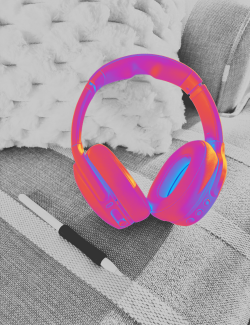
Life was the same as before, just softer. Conversations were careful and measured. Headphones and earplugs were the new fashion accessories. Everyone used pocket cards with block-printed phrases.
The Fragmented, or “Frags” in less polite company, walked among us. They looked perfectly normal until they spoke. Depending on their G-level, you might not even know they were infected. That’s why ear protection was so important. One overheard sentence was all it took.
“How was your day, dear?” asked Molly as I entered her home office. She spoke carefully, in a soft, measured tone.
Even with the smaller, lighter house headphones, I still had to strain to hear her.
Was. Your. I repeated the safe words to myself and smiled at her.
“Jefferson has slipped to G-2. Last week was tense. He spent the entire day calling me Mr. Brooks.” I emphasized the important words: has slipped, he, spent.
“Be careful around him,” she whispered.
I nodded. “I am. But editors talk to people. Interviews, meetings, all of it.”
I waited while she typed. “That briefing last month was a disaster. Half the press pool was exposed. And now Jefferson’s lost pronouns.”
“Let me finish this chapter,” Molly said. “Then I’ll join you.” Me. I’ll. You.
I moved to the living room to unwind. I switched on the television, instinctively hitting the mute button, even though we’d disconnected the speakers years ago. The CDC guideline glowed at the bottom of the screen, permanently beneath the closed captions. Avoid Auditory Interaction with Symptomatic Individuals.
There was no need for news anchors, but the networks kept them out of habit. I chuckled, remembering the old predictions that cable and streaming would kill print media. Lucky for me.
After dinner and chores, we lay in bed listening to the night sounds. I finished her latest chapter and slid the pages back into the folder, then handed it to her.
“You’ve made some good changes. It will be fantastic.” You. It. Will.
She smiled and set the manuscript on her nightstand. Even with the earplugs, she could hear me. Everyone wore them, even at night. Sleep talking was especially dangerous.
“Good night,” she said. “I love you.” She said the three words slowly, as always. Slow enough that I nearly missed her hesitation before “you.” Maybe it was nothing.
I had forgotten it by morning. Nothing sounded odd over breakfast, and the kiss on my cheek as I left was followed by a steady, “I’ll see you tonight.” No hesitation.
The Fragmented were everywhere as I walked to the subway. The G-1s were the hardest to spot. The young man taking my coffee order could have been infected, or maybe just brash.
“Hello. What you want today?”
I couldn’t tell. I used my cards.
Even the G-2s could pass. Maybe Jefferson was just being polite.
But the rest were obvious.
The woman in the ticket booth, herding us into the subway car was a clear G-3. “Line move. Person go.” They were tolerated.
And the poor G-4s. The most fragmented of all. I encountered at least one panhandler a day, “Help. Please. Money.” Eventually they vanished. Removed, “for their own protection.” We all knew what that meant.
I thought about Molly throughout the day. Although my job was riskier—more people, more words—she still needed to be careful. There was no cure, and the vaccine was always a few months away.
At home that evening, Molly was noticeably down.
“Harriet’s got it now. She tell me today,” she said over dinner.
My fork hit the floor with a metallic ring. I heard it clearly through the house headphones.
“What is wrong with you?” she whispered. You.
She hadn’t noticed.
“Nothing. Just slipped,” I lied, picking it up. “Sorry.”
Maybe I misheard. I readjusted my headphones, determined to catch every word for the rest of dinner.
By bedtime, Molly noticed my mood shift. She asked, but I couldn’t tell her. I didn’t know how.
“Hopefully you feel better tomorrow,” she said, turning off the nightstand light. I lay alone in the dark. I removed my earplugs and listened to her deep breaths for several minutes.
It’s manageable, I thought. We just need to be extra careful. G-1 isn’t too bad.
I replaced the earplugs, convincing myself for a moment.
Most people won’t even notice.
By the end of the month, it was unmistakable.
“I miss you today.”
“I prepare a special dinner tonight.”
“Do you remember when we last see your mother?”
My involuntary winces were visible to her, no matter how hard I tried to hide them. She saw them every time. She tried to steady her speech, but the slips continued. And she refused to be shut away because of them.
“We still must live our lives,” she’d said in the early days. “Otherwise, what’s the point?”
She was right of course. There was nothing to do but be careful. Keep the headphones on. Use pocket cards instead of talking.
It was hard. But there was no alternative.
As the seasons passed, I grew accustomed to her speech. The wrong tense no longer sounded wrong. I knew what she meant. It felt natural.
One morning, she kissed me on the way out.
“I love man. Have a good day.”
She closed the door as if nothing had happened. I stood outside on the stoop, unmoving. Tears swelling in my eyes.
We knew this was the tipping point. The Fragmented could live reasonably normal lives at G-1 or -2. But past that… I didn’t want to think about it.
Molly was headstrong. I loved that about her. And now it terrified me.
I pleaded and begged. It wasn’t punishment; it was protection. For others, and for her. A G-3 could be mistaken for mean or ignorant. A G-4 could be mistaken for dangerous. People didn’t mean to be cruel. They got scared. And then desperate.
I threatened and warned. Unwanted attention meant isolation. On their terms: “auditory restabilization internment.”
“I am not an invalid,” she shouted. “Molly not stay lock away!” She was right, of course. Otherwise, what’s the point?
She seemed so normal. So familiar. But her words still hit like daggers. Each missed tense. Each missing pronoun. Another page in the novel she’d never finish. And if she slipped in public… I couldn’t bear to think about losing her.
My return home each evening was filled with dread instead of serenity, reopening the wounds every time. By the time she started dropping articles, I hardly noticed.
“Man not shut door. Cat almost escape,” she scolded me one afternoon. I sheepishly closed the screen door, her grammar barely registering anymore.
I’m not sure what’s harder: listening to the fragments, or realizing she doesn’t even notice. She’s still the same, right?
She turned in bed to kiss me goodnight.
“Molly. Love. Man.”
“I love, too,” I said. “I see you in the morning.”

About the Author:
Rick is a career UX and technical writer by day, and a fiction author by choice. After years of documenting software, gas pumps, and database tools, he’s still working on keeping it out of his prose. His wife edits and fixes most important things—including his stories and wardrobe. They live in North Carolina with their excellent dog, one good cat, and one less-good cat.