Posted on 1 Comment

The Hollow in the Hedgerow

An Acorns Flash Fiction Feature

By: Subham Rai

Greta walked the hedgerow every morning for forty-three years, ever since Tom built their cottage on this quiet patch of land. The hedge stood older than either of them, a dense weave of hawthorn and blackthorn laced with ivy that held fast like lingering memories. It separated their small world from the open fields, a barrier that flowered white in spring and bore red berries in fall.

Lately she moved more slowly. Her knees complained on the uneven path, and the basket on her arm dragged even when empty. Tom had left her three winters past, claimed by a chill that took root in his lungs and would not let go. The cottage felt too still without his low songs while he fixed tools or tended the stove. She missed the way he paused to listen to birds or comment on the weather, his voice a steady comfort through the days.

One morning mist drifted close to the ground, turning the fields to soft grays and faded greens. Greta stopped where the hedgerow curved into a low arch she had always called the gateway. A shadow among the roots drew her gaze, a dip in the soil that formed a small hollow no larger than a rabbit burrow.

She knelt, joints protesting, and swept aside fallen leaves. The opening ran deeper than expected, a smooth passage edged with roots that caught the faint light. A cool draft rose from it, scented with earth and a trace of apple blossom though no trees bloomed nearby.

Greta paused. At seventy-two, new wonders should have lost their pull. Yet the hollow waited, steady as the hedge around it. She wondered if loss had sharpened her sight for what lay just beyond the ordinary.

She reached inside. Her fingers brushed cool space, then cloth. She pulled out a small handkerchief, faded but marked with stitches she remembered making: T & G, hearts linked. Tom’s gift on their wedding day, misplaced long ago during a picnic beneath these branches. She turned it over in her hands, tracing the careful embroidery that had survived untouched by time.

Her breath shortened. The fabric lay fresh and whole, as if the years had passed it by.

“Greta.”

The name came soft on the draft from below. Tom’s voice, rough yet kind as ever.

She held the handkerchief close. “Tom?”

Silence answered, broken only by leaves stirring overhead. Still, the hollow appeared wider now, almost welcoming. She leaned nearer, drawn by a gentle glow rising within, not daylight but something calmer. Pictures formed like scenes on quiet water: Tom young and smiling, lifting her among apple boughs on their wedding day; Tom older, showing their daughter how to set seeds in rows, his patient hands guiding her small ones; Tom near the end, gripping her hand as snow gathered at the window, his eyes steady even as strength faded.

These were more than recollections. They carried sharp detail. She smelled crushed grass from that distant picnic, felt the heat of his hand in hers, heard the laughter of their daughter echoing through the years.

The hollow returned their shared years to her, moment by moment. Greta lingered there that first day until her knees throbbed and the light shifted. She saw their life unfold in pieces: delight at their daughter’s arrival in a rush of spring rain; sorrow when she left for the city, waving from the bus with promises to write; the steady kindnesses that shaped four decades into something solid, like the way Tom always saved the best apple for her or mended her favorite shawl without being asked.

Certain scenes stung. Disputes over scarce coins during hard winters, quiet stretches after their daughter moved away, the gradual fading of Tom’s vigor as illness crept in. Yet love ran beneath every ache, a quiet current that held them together.

As evening settled and mist rose higher, Greta drew back her hand. The pictures dimmed, but the handkerchief stayed warm against her skin. She folded it carefully and tucked it into her pocket, rising with effort to continue her walk. The fields seemed a little less empty that day.

She came again the next day, and the day after. The hollow never spoke, yet it seemed to hear her. She told it of the vacant chair at meals, the garden Tom once kept neat with rows straight as his carpenter’s lines, the long stretch of nights when sleep came slow. She spoke of small things too: how she still set two cups for tea out of habit, or found his old jacket hanging in the shed and pressed her face into the fabric to catch any remaining scent of him.

One morning clouds promised rain. Wind shook the hedge, scattering early leaves, and Greta carried her shawl along with a tin of Tom’s plain biscuits, edged dark as he preferred. She settled near the hollow, knees folded beneath her, and shared one biscuit with the draft rising from below.

The hollow waited. This time it offered fresh images: herself over the past three years. Greta alone in the cottage, working the garden by habit with hands that moved slower each season. Greta by the fire, speaking to no one as flames crackled. Greta tracing the hedgerow each dawn, seeking what she could not name in the familiar paths.

She saw herself grow spare and silent. Saw the spark fade from her own eyes, replaced by a dull patience that carried her through days.

Tears welled, sudden and warm. “I don’t know how to manage without you,” she murmured into the opening, voice breaking on the words she had never said aloud before.

The cool draft lifted once more, scented with apple blossom though winter neared. No voice replied, only quiet acceptance. The scenes turned to their beginning days: Tom guiding her to plant potatoes, both laughing when she set them too deep and had to dig them up again. Tom raising the cottage stone by stone on weekends, vowing a home to endure beyond them while she brought him water and watched with pride.

The hollow reminded her what endured: the garden pushing through soil each spring, the cottage standing firm against wind and weather, her hands yet able to care for both. She saw flashes of future seasons too, brief and gentle: bulbs blooming where she planted them, neighbors stopping by with shared meals, quiet evenings by the fire with memories no longer sharp but softened like well-worn cloth.

When she rose at last, legs stiff from kneeling, rain had begun, a gentle fall that brightened the hedge and washed the paths clean. Greta slipped the handkerchief into her pocket. It rested lighter there, as if some burden had lifted.

She did not seek the hollow daily afterward. Some mornings she turned soil and set bulbs for spring, hands steady in familiar work. Others she baked proper biscuits and carried them to neighbors who had lost partners of their own, listening to their stories in return. She found comfort in small routines, in watching seasons turn as they always had.

The hollow stayed beneath the hedgerow, patient as ever. When loneliness pressed sharp on quiet evenings, she returned. It offered no judgment, only fragments of their life together, showing her that love does not vanish. It sinks into roots and waits for the proper season to rise again, in new growth or shared remembrance.

Years on, when Greta’s hands stiffened too much for garden work, she often sat beside the hedge with a cup of tea, watching light shift through leaves. Children from nearby farms sometimes found her there, sharing tales of the old woman who spoke to the plants and seemed to know secrets of the land.

They never noticed the hollow. Yet on misty mornings as they passed, they caught the scent of apple blossom out of season and felt, for an instant, wholly known. Greta smiled at their wonder, remembering how such small gifts had carried her through long seasons of loss. The hedge stood as it always had, a quiet guardian between worlds, holding memories for those who needed them most.

About the Author:

Subham Rai is a writer from Kolkata, India. His work has appeared in Strange Horizons, Macramé Literary Journal, Cohesion Press, Zoetic Press, Bindweed Magazine, Graveside Press, Horror Tree, and Consequence Forum. Forthcoming pieces will appear in DreamSpinner Press, Dead Fox Publishing, Cupid Arrow Publishing, Cliffhanger Magazine, Plotthound Magazine, and Vellum Mortis. He can be found online at https://linktr.ee/subhamraiauthor.

Posted on Leave a comment

Yutsuki’s Flower

An Acorns Flash Fiction Feature

By: David McGillveray

Daimyo Imagawa stepped on to the quayside still furious with the lords of the other islands. Negotiations had gone badly. Well, they would soon find out that taxes could be paid, or they could be collected.

The thought lightened his mood a little as he marched through the harbour, a phalanx of samurai at his back. Imagawa ignored the fisher folk who fell over themselves to get out of his way.

His fortress crowned the island of Ukejima, dominating the land and the sea.

“I will take the garden entrance,” he told the attendant that waited for him, Takanashi. It always pleased him to take a moment in the garden on his return home; its beauty and its order calmed him. But once through the gate he pulled up short. Something was not right.

A lone figure in blue peasants’ garb kneeled among the rocks of the garden, working at something in the soil.

“You!” Imagawa shouted. “Who are you?”

The figure turned to stand facing him, head down, hands together. A young woman, little more than a girl. Her hair was cut short like a boy’s, but her frightened face was heart-shaped and beautiful.

“My name is Yutsuki, Lord,” said the girl quietly.

“What are you doing here? Where is the proper gardener?”

“My grandfather died, Lord. Do you not remember that you dismissed him? The garden was everything to him.”

Daimyo Imagawa looked momentarily confused. He frowned. Oh yes, the silly old fool had left a rake in the path. He had nearly stepped on it. “Well where’s his replacement then?”

Takanashi whispered something in his ear.

“So find someone, then,” Imagawa bellowed. “And throw this creature out. Women are not permitted in my garden.”

Two of the samurai took Yutsuki by the arms and pushed her out through the gate. The lord of the island glared after her, his peace ruined. He stamped towards his apartments, casting a critical eye across the rockery, the water features and the gravel. Much work was needed. Much work.

He did not notice the tiny white flower growing newly in the centre of the garden.


In the morning, Daimyo Imagawa had decided. He gave orders to muster a company of men from the fortress and the barracks in the town. Those insolent lords would pay what he was due, including additional fines in blood.

He felt so much better that on his way to the harbour he decided to linger in the garden, to savour the silence and the retribution to come. But once again his pleasure was spoiled. Lines were not perfect; elements were out of place. A white flower the size of a dinner plate grew among the rocks making up the garden’s central feature, pretty enough, but not right.

“Takanashi, if this garden isn’t to standard when I return I’ll have your head on a spike and the rest of you in the fire!” he roared into the morning quiet, and headed off down the hill.

The lord filled three ships with men and sharp steel and put to sea.


Once more, Daimyo Imagawa came home. The harbour was quiet, the atmosphere of the town sombre to match his mood – news had travelled back ahead of him. The neighbouring islands had met his forces and demands with unexpected resistance. Lord Sanjo’s men had even reinforced Lord Ogimachi in a pitched battle on the latter’s beach. It was unheard of! Hitherto, every other lord would rather have seen his rivals choking on their own blood than lift a manicured hand to their aid.

Insult of insults, Imagawa had received a glancing blow from a stone thrown at his retreating company as they fell back to their ships. He scratched at the wound now, flakes of rusty blood under his fingernails, and rage boiled within him.

He returned to the fortress only to be confounded further. He opened the gate to the walled garden to find the entrance barred by a profusion of white petals, each nearly as big as a man, their scent overpowering in his nostrils.

“What is this?” he sputtered. The soldiers behind him muttered their bafflement. “Takanashi!”

He found the attendant cowering in the main house. The man fell to his knees before his lord. “It is sorcery, Lord. When you cut it, it only grows back faster.”

“Nonsense, man. Did you find a gardener who might actually know what they’re doing?” sneered Imagawa.

“There are none to be found, Lord,” Takanashi whined. “The peasants have been drifting away, leaving Ukejima.”

Imagawa drew his katana from his belt. “Then why didn’t you stop them then?” he thundered. Takanashi scraped lower at his feet. “I ought to take your head right here. Get down to the town and select a dozen men, women and children and execute them on the quayside. Immediately! Make sure everyone sees. I’ll have no deserters. I want wailing in the streets!”

“At once, Lord.” Takanashi grovelled from his presence.

With weapon still drawn, Imagawa strode to the house entrance of the garden and sliced at the huge flower that now, incredibly, filled the whole space, pushing against the inner walls. The sharp blade cut into the tip of the nearest petal and stuck there. He wrenched it free. To his amazement, the wound closed before his eyes. Furious, he swung the katana and hacked at the growth again and again, chopping pieces into the air and scoring long slashes in the flower’s leathery flesh until at last he sagged back, exhausted. The graze on his head throbbed.

He watched blearily as the petals repaired themselves, grew anew, the glow of its inner life reasserted.

In the night, a crashing noise awakened Imagawa from an uneasy sleep. Part of the outer wall of the garden had collapsed. Unnatural white petals pushed through the paper panels of the house.

Daimyo Imagawa put to sea the next day with all the men he could muster.


The lords of the other islands had had enough of Daimyo Imagawa. For years they had suffered his taxes, his cruelty, his arrogance and that incredibly annoying strut as he walked into their palaces and fortresses as if he owned them, which he thought he did. Well no more!

The newly elevated Daimyo Sanjo had succeeded in uniting the squabbling lords under common cause. Their combined armies ambushed Imagawa as his forces laid siege to a suspiciously undermanned stronghold capping one of the nearby islands. They harried the survivors into the sea and all the way back to Ukejima.

Daimyo Imagawa found no sanctuary there. He stared, appalled at what he saw. His people had left him and his island had become changed. Fire burned his sails and arrows pierced his armour and his final expression was one of bewilderment to see the beauty that had replaced his ugliness.


The great flower bloomed from the crown of the hill, waves of white petals flowing down to the shore in a blanket of such beauty that the whole island shone like a jewel with the rising sun. The island was the flower, the flower the island. In time, the flower hardened to stone, like a sculpture carved by a god and set upon the surface of the sea.

Of Yutsuki, nothing was heard, but in the years that followed the islands became renowned for the beauty of their many gardens.

About the Author:

David McGillveray was born in Edinburgh, Scotland but now lives with his family in London. His fiction has previously appeared in Clarkesworld, Analog, Interzone and others. His story collection Forgotten Dragons, Plastic People is available through Amazon.

Posted on Leave a comment

From the Editor’s Desk

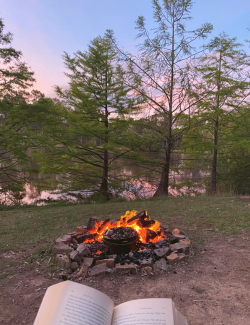
Reading a book in front of a campfire, with a pine tree line and sunset in the background

As we come into spring and the blossom of seasonal allergies and bug bites, I’ll be spending the newly bright, warm weather reflecting on coziness.

We aren’t a “beach reads” sort of publishing house, but I think the beach can get whatever read you want to give it, so take that, summer. I’m not exactly Morticia on vacation over here, but to be totally transparent (much like my skin in July thanks to my SPF 1000), I’m not really a summer person. I love a fluffy blanket, a hot drink, and dim lighting, and all of that is tough to enjoy during the season of sweat and blinding sun.

But our next anthology, The Ordinary Magic in Extraordinary Tales, is all about coziness. Our official release date is TBD, but it’ll be just as the leaves burn orange in cool sunlight, the breeze nips your skin, and the nights get just a little bit longer. We have fourteen cozy fantasy stories for you, each more delightful than the last. They’ll be grouped thematically and paired with essays written by yours truly on how to curate a cozy life for yourself, full of conviviality and contentment.

If you didn’t know, I have a graduate degree in educational psychology and a decades-long background in recovery-based mental health. This book is a real passion project for me that combines two areas of great interest.

Let’s be real, though. All of our books are like that. I love them all—this one’s just a different type of intersection for me.

If you aren’t familiar with the cozy subgenres, the concept is a smaller cast of characters, and a more upbeat and optimistic tone. The plots have action, adventure, and emotion, but they’re lower stakes that are more about interpersonal relationships and personal development rather than world-ending issues.

Anyway, the stories have been chosen and we’re working on finalizing the last of the contracts with our authors, as well as on the details of the book. I can’t wait to get these tales out to you. There’s a wonderful mix of fantasy elements across the stories, including witchy tales, dragon tales, and ghost stories. We have modern day magic, second-world mysticism, and post-apocalyptic settings.   

Choosing the final stories for the book was really difficult, and the overall quality and quantity of submissions this time really blew me away. I had to reject some that I loved out of considerations like physical layout space and theme. It’s such an honor to attract so many talented authors willing to trust us with their work, and it allows us to build out our concept in the best, most complete way that we can.

Next up, we’ll be finalizing the cover and the essays, then the book will go to our amazing and talented layout editor, Austin Gray.

In the meanwhile, I’ll be doing a lot of reflecting on how coziness is a mindset, and how we can always make the choice to live a life of simple pleasures and contended relationships. Even while swatting mosquitos in the dead of summer.

Posted on

9 Questions for Ellis Reyn

We caught up with Ellis, author of the delightfully unsettling story “Pink,” from our debut project The Wordsmiths.

Ellis: I’m Ellis Reyn, a thirty-something novelist. Enneagram 5, Capricorn, eldest daughter, cat person. My novel-length work sits somewhere between romantic thriller and literary fiction—stories about complicated women, the ways they survive things they probably shouldn’t, and how they find love with green-flag men along the way.

I live in North Carolina with my husband, a cat unironically named “Cat,” and our four kids, which means my life alternates between writing very dark things and packing school lunches.

Ellis: I write in the little pockets of the day. Right before appointments from the passenger seat of the car, late at night when the kids are finally in bed, or during rare quiet mornings when the house miraculously empties out.

I’ve learned that butt-in-the-chair time is the most important thing. Tiny progress is still progress.

Ellis: I have a desk under a huge window that looks out over the woods. That’s where serious writing happens. But in reality, I usually write in bed with my laptop balanced on a pillow (RIP my upper back). Wherever I can get words on the page is the perfect writing space.

Ellis: When I was a kid, I wrote a short story from the perspective of a horse during the Gold Rush. I printed it out, stapled it together, and put it in my dad’s lunch box so he could read it during his break at work.

He did read it—and I’ve felt like my dad was my biggest fan ever since.

Ellis: I’m working on a contemporary romantic thriller set in the Mojave Desert about a beautiful rehabilitation center. Think cult-adjacent wellness, tiny smoothies served at an all-day health-food buffet, a lot of white linen and patchouli… and body horror.

I’m also on submission with a Southern Gothic. So please send me all the good publishing vibes!

Ellis: As much as I can!

My TBR pile is always slightly out of control with lots of horror (especially women-written) and historical romance. They’re genres that feel different but are both excellent at exploring big emotions.

Right now I’m reading Black Sheep by Rachel Harrison. I can’t recommend her horror enough! I’m catching up on Alexandra Vasti’s historical romance backlist next. 

Ellis: The uncertainty. Writing a book (and then trying to publish it, my goodness) takes a long time, and a lot of that time is spent alone with your doubts.

The best thing I’ve found to do is to keep going. Write the next page, revise the chapter, start the next idea. Do the next right thing. 

Ellis: With four kids, there’s always something happening around here. Apart from endless school pickups and drop-offs, I read a lot, sweat through Pilates and hot yoga, hunt down good strawberry matcha with friends, and rewatch the same comfort shows while folding laundry. The usual!

Ellis: You can find me online at: Instagram: @ellisreynbooks

Posted on 1 Comment

Live-Journaling

An Acorns Flash Fiction Feature

By: Karl El-Koura

Thank you for joining me on this live read-through of what’s supposed to be the greatest horror novel ever written. The book is claimed to actually be haunted by readers with overactive imaginations. On Goodreads the reviews spend more time chronicling people’s paranormal experiences than discussing the novel’s literary merits. The Amazon reviews are a series of warnings to read the whole thing in daylight and surrounded by friendly people.

So consider yourself warned, especially if you’re on your own at night! (With apologies for spoiling anyone’s fun, though, I don’t believe a word of those “experiences.”)


I stand by what I said, but boy do our minds play tricks on us! Especially in the dark.

I’m in my office, sitting in my most comfortable chair and sending these notes from my phone as I read through the book—yes, to all the fifteen people actively watching this thread right now. My wife and kids are asleep upstairs. No one else is in the house. But, just as the main character catches a glimpse of the dark creature crawling across the ceiling of his bedroom, I heard something in our basement. Thought I heard something.

It’s kind of funny, really.


I heard it again, just as the main character goes for a midnight run.

For the record: no one else is in our house. I went downstairs; I turned on all the lights. Just to be sure, right? No one is there. Obviously the novel’s bleak atmosphere is seeping into my mind! What possessed me to start reading this book so late at night?

Well, if you believe the people on Goodreads—and I don’t!—the only way to exorcise whatever has come into your house is to finish reading the novel.


I was convinced the reviews were fake, everyone’s tongue planted in their cheek. But I’ve been hearing the noises in the basement again. They started up as soon as I came back to my office and sat down. Someone’s walking around in my basement, trying to be quiet about it, but I can hear the footsteps.


I skipped ahead, to the last paragraph—he finally decides to seek help for his addiction to amphetamines, which of course is what is causing his insomnia. The sun rises over the hospital as he checks himself in. I skipped ahead, thinking I’d…stop hearing things. I’ve read the final paragraph twice. The first time I heard a creak on the stairs…I know it’s a step mid-way up the stairs that creaks. The second time I heard nothing for a while, and thought everything was fine and started laughing at myself, then I heard it—the sound of weight on the top landing, where the carpet gives way to tile. The reviews don’t tell you this, because they’re not real—most of them, I mean. But: you can’t skip ahead.


I’m typing into my phone whenever I feel myself getting tired. It helps me stay focused. Alert. I’ve read as quickly as I can, but I can’t finish, can’t finish before it reaches me, whatever has come up from my basement and is now slinking toward my office.

I’m going out to face it.


There’s nothing there. I’ve turned on all the lights on the main floor, all the lights in the basement. I’ve left everything on. Should I wake up Maisy? But she’ll laugh at me. Deep breath—I am being crazy, though. There’s nothing there!


Heard the footstep—just outside my office. I’m so tired—but I can’t go to sleep. I have to keep reading to the end.


The door to my office is open. I should’ve closed it—but, no, I couldn’t do that! Close myself in. But I can feel it, sense it—I’ve felt it for the last page or two, standing there, watching me. I don’t want to glance over; I think I know what I’ll see. I want to finish reading this book.


I’ve caught myself trying to fall asleep. My eyes having a mind of their own, trying to trick me into giving them what they want.


I saw it. I couldn’t take it anymore, not knowing—I looked over, and it retreated, but not before I glimpsed its light-sucking voidness. Like looking into a hole in reality. It’s the Netherwere from the novel, the shadow-creature that wants to take over the main character’s body and life. I saw it.


What does it want? It wants me to fall asleep. Like the Netherwere in the novel, its power is greatest in the liminal state between wakefulness and sleep. Only in that moment—in the novel, I mean—can it leap forward and inhabit you, evicting you from your own body, taking over your life, turning you into a Netherwere to seek out your own tired victim. It stalks our hero but never gets him, because he doesn’t fall asleep—at least, not until he checks himself in.

People…it can’t stand other people. I should wake up Maisy. It’s a small price to pay, being laughed at, isn’t it?

But if I can just power through to the end of the book, I won’t have to explain why I woke her up in the middle of the night like a frightened child. I can make it.


Caught myself again, drifting off. Can’t let that happen.


Well—I hope I didn’t pull your leg too long. There is no such thing as Netherweres, and they can’t enter our world seeking bodies for themselves.

No, the claims of this book being haunted, or being a conduit to another reality, are not true, of course. It’s a very good book.

You should read it for yourself.

About the Author:

Karl El-Koura lives with his family in Ottawa, Canada’s capital city, and works a regular job by day while writing fiction at night. To find out more about Karl, visit his website at ootersplace.com.

Posted on

A Sense of Place

This weekend, we embraced our roots.

Two of our team members attended the Writers Conference of Northern Appalachia (WCoNA) deep in the Appalachian countryside in Cambria County in our home state of Pennsylvania.

Writing is an isolative act, and if you’ve had more than a few minutes’ worth of conversation with me about writing, you’ve probably heard my impassioned speech about how writers need writers. Usually I sing the praises of writing groups, but today? Today’s about feeling part of something even bigger.

Conferences.

WCoNA is a real gem. It’s big enough to walk away each year with new connections, but intimate enough to have real conversations with the presenters and attendees. The focus is on craft, and the full day on Saturday offers five sections, each with multiple topic options to attend. There’s something for everyone, from poetry to fiction, from memoirists to novelists.

What makes this my favorite conference, though, is the focus on place.

WCoNA holds up a mirror for me and then says, don’t look into your own eyes. Look around. Look behind and beside yourself.

All of the attendees are connected deeply by our sense of place, and even though we have sessions on marketing and building craft and submitting our work, thematically the organizers wrap us up in Northern Appalachia.

And I love it.

From the panel and open mic on Friday night to the keynote address Saturday morning, we were steeped in the experiences of the rust belt. Of coal and oil and natural gas mining that stripped our land and our families bare. The unspoken kinship of our grit and resilience, that rose out of the clouds of dust from our dirt roads on dry days. The Appalachian wilderness that fostered the wildness in our hearts.

WCoNA is a reminder of who I am, and of the importance of introspection. I don’t necessarily write about Northern Appalachia, although some of my pieces are set here. I don’t necessarily center place in my writing, although it’s certainly informed by my experiences here. We are all a sum of our parts, and place is an important one. If you haven’t done much introspection on place, I’d strongly encourage it. Being intentional about place in your writing adds depth and layers to your story, and creates a richer and more memorable experience for your readers.

This weekend, I had the honor to sit among a group of like-minded people, all acutely attuned to how this place has molded us.

And I can’t wait to do it again next year.

Posted on

The Last Page is Always Warm

An Acorns Flash Fiction Feature

By: Khayelihle Benghu

The Last Page Is Always Warm

The first time Miriam noticed the warmth, she thought it was the radiator.

It was early October, in the late hours of the afternoon, when the library grew hollow and echoing. The old pipes beneath the floor ticked and complained like tired bones. She had been re-shelving returns in the history aisle where the spines were old and some darker, the fonts more ancient. When she pulled a paperback from the drop cart, she felt heat against her palm, not body heat, no, not quite.

The book was warm the way a mug might be warm long after the tea inside has gone cold.

She held it there, confused, before checking the cover.

The Long Watch, by Arthur Bell. No dust jacket and slight curl at the corners. The library stamp inside was faded, as if impressed decades ago. She pressed her thumb to the pages and found them still warm.

Miriam looked around, half-expecting a prank, but the aisle was empty. The overhead lights hummed and the windows showed only her own reflection, thin and pale, framed by shelves.

She set the book aside and finished her shift.

The book must have embedded into her subconscious. That night, she dreamed that inside the library, the pages were live and they scanned her fingerprint.

The next afternoon, the book was back in the returns cart.

Miriam frowned. She was meticulous, had always been. She remembered placing The Long Watch on the shelf between two anthologies. However, here it was again, spine scuffed, pages faintly warm.

This time, curiosity overcame her caution. She slipped it into her bag at the end of the day and checked it out under her own name.

At home, she placed it on the kitchen table and let it sit while she made soup. The steam rose and the windows fogged. Still, when she returned and touched the book, it was warm in a way that did not belong to rooms or weather.

She opened to the first page.

The prose was spare, almost old-fashioned. A man standing watch in a lighthouse and the sea restless. The isolation familiar, Miriam read a few pages and then paused.

There was a line she did not remember from the first paragraph.

He thinks of the sound his wife made when she slipped on the rocks.

Miriam read it again and her throat tightened, becoming dry as if something was lodged inside it.

Arthur Bell’s wife had died that way. It was a minor detail mentioned in an obituary she had read years ago when cataloguing local authors. A coincidence, she told herself. Writers borrowed from life all the time.

She turned another page. The book was warmer now.

Miriam began to notice changes, sentences shifting and details deepening. Passages that felt less written than remembered. The lighthouse keeper began to think thoughts Miriam herself had once tried to forget: the hospital room with its too-clean smell, the way her mother’s hand had gone slack mid-squeeze, the silence afterward that felt heavier than grief.

She closed the book, her heart racing.

The warmth lingered on her fingertips.

For two days, she avoided it. She returned to work, catalogued donations, and answered patron questions. Almost pretended not to notice how often people paused in the history aisle, touching spines as if testing with their fingers.

On the third night, she opened the book again.

This time, the lighthouse keeper was no longer alone.

There was someone standing just beyond the reach of the light. Someone familiar, maybe someone he loved and had lost. The prose did not describe the face directly, but Miriam knew it anyway.

Her mother’s face, as it had been before the illness. Miriam slammed the book shut.

The cover was hot now –unmistakably so. She dropped it onto the table, breath shallow and pulse loud in her ears. She did not sleep that night. The following week, a patron approached the desk holding The Long Watch.

“Excuse me,” the woman said, eyes twinkling. “Is this new?”

Miriam stared. “No,” she said too quickly. “It’s old stock.”

“It feels alive,” the woman whispered, almost apologetically. “I’ve never read anything like it.”

Miriam swallowed hard. “I’m afraid it’s… fragile,” she said. “We’ll need to keep it in the archives.”

She took the book with careful hands. It was warm again, even through her sleeves.

That night, she locked it in the back room, inside the metal cabinet reserved for rare and damaged items. She told herself this was enough. That stories, however strange, were only stories. However, warmth is patient.

Miriam began to notice patrons lingering longer in the back room when she fetched holds. Fingers brushing the shelves and their eyes unfocused. One man stood too close to the cabinet once, breathing shallowly, as if listening for something inside.

She moved the book again. Wrapped it in archival paper. Placed it in a locked drawer within the cabinet, but the warmth seeped through anyway.

Feeling almost haunted, she dreamed of pages turning themselves. Hands reaching out from margins, of a lighthouse whose beam swept not over water but over memories, illuminating moments she had buried. The arguments left unresolved, words unsaid and the particular way grief could feel like being watched. When she woke, her palms were warm. Miriam tried to research Arthur Bell, but records were scarce. His biography was thin, contradictory, and one note in an old newspaper mentioned that the final manuscript of The Long Watch had been unfinished at his death, discovered among his papers with “no clear ending.”

She checked the library copy.

There was now an ending.

The lighthouse keeper, aged and tired, stood before the light for the final time. The warmth was unbearable. The presence behind him no longer waited in shadow. It stepped forward, and the prose grew intimate, tender.

He understands now that someone must remain.

Miriam felt a pressure behind her eyes.

The final paragraph was written in a hand that felt uncomfortably close to her own thoughts.

The watch does not end. It is passed.

She closed the book slowly.

It was hotter than she could comfortably hold. She considered destroying it. Fire would do, she thought. Or water. She imagined the book sinking into the river, pages bloating, ink bleeding away. However, the warmth felt almost pleading now. Not malicious, no, not exactly. But lonely.

That night, the power went out at her apartment. Darkness pooled in corners. She lit a candle and sat at the table, the book between her hands.

Her mother’s voice came to her, not as sound, but as presence, familiar warmth. The ache of connection.

Miriam felt aggrieved and wept. Not loud but in silence. She let herself read—the final pages had expanded again.

They spoke not of the lighthouse keeper but of a woman in a quiet building full of books. A watcher. A caretaker, someone who noticed what others passed by. Someone who listened.

The warmth grew steady, no longer threatening, but expectant.

The next morning, Miriam returned The Long Watch to the history aisle.

She did not stamp it. Did not catalogue the changes. She slid it into place and stepped back.

A young man reached for it moments later, eyes widening at the touch.

Miriam watched him go, heart heavy and calm all at once.

At the end of her shift, she noticed something strange.

Her hands were no longer cold.

Over the weeks that followed, the library felt different to her. It felt fuller and charged. She sensed stories breathing behind their covers and seemingly waiting. She began to linger after hours, walking the aisles, touching spines, feeling warmth bloom and fade.

Sometimes, when she paused long enough, she felt memories stir hers, others indistinguishable and some human. She understood now.

The watch does not end. It is passed, and the last page, she learned, is always warm.

About the Author:

Khayelihle Benghu is an emerging author residing in Johannesburg, South Africa. Except writing she has a heart for photography, mainly nature.

Posted on

Tuberculus Mom

An Acorns Flash Fiction Feature

By: Mario Senzale

I was assigned to Brother Kartoffel right after growth season. Some got hunting. Others, construction. I got planting.

“You’re strong,” the elder said, looking me over. “Good build. You’ll do fine with the mothers.”

I knew what that meant. Everyone did. The rooting ceremony. The mothers go down, they feed the earth, the earth feeds them, and the young ones come up stout.

On the first day, Brother Kartoffel showed me how to dig the beds. Six feet down, four feet wide. The soil in the north fields is perfect for it—dark, moist, full of nutrients.

“Make it cozy, Brother Arnut” he said. “They’ll be here for a while.”

“How long?” I asked.

“Six months. Sometimes seven if the young one’s stubborn.”

We dug four beds that week. Sister Wortel, Sister Rote, Sister Ube, and Sister Neep. The ceremony was on Sunday. The whole commune came out. Drums, singings, the elders blessing the soil. Sister Ube went first. Six months along, her middle huge and low. She walked to the field wearing nothing. Smiling. Covered in compost and manure. The women had prepared her since dawn, layering her in the mixture. She spread her arms to the crowd.

“This is my gift. My body for the earth. My young one for the future.”

Everyone cheered. Brother Kartoffel and I helped her into the bed. She lay down, still smiling, hands on her swollen middle. The compost was packed around her, thick and warm. Her face was the last thing visible.

“See you at harvest,” she said.

We covered her. The soil went on easy, and the women sang. When we were done, Brother Kartoffel hammered the stake into the ground. “Sister Ube—3/17.”

Sister Wortel came after, followed by Sister Rote and Sister Neep. All of them smiling. All of them honored. The ceremonies were always the same. Joyful. At night there was a feast. The whole commune celebrated the new plantings. Brother Kartoffel got loose on Kombucha and told stories about harvests from when he was young.

“You’ll see, Brother Arnut,” he said, his arm around me. “When they come up, it’s magic. Magic. And we—we have the front seat.”

“What do they look like, Brother Kartoffel? What do they look like?”

“Reborn, Brother Arnut. Reborn.”

“And the young ones, Brother Kartoffel? The young ones?”

“You’ll see, Brother Arnut. You’ll see.” He smiled.

I went home late. The light was fading. I drank water, lots of it, and stood in my yard for a while, feeling the start of spring.

Three months in, the soil above the beds started swelling. Rising up like bread. Brother Kartoffel said that was normal. It meant the mothers were growing.

“The seedling feeds them through the cord. Gives them what they need to survive. Nutrients, minerals. Keeps them strong.”

“So they’re alive?”

“More than alive. They’re becoming!”

One morning I was checking the irrigation system and heard something coming from Sister Wortel’s bedding. A hum. Low and steady. I knelt down and pressed close to the soil. Slow and thick. A heartbeat.

“Beautiful, isn’t it?” Brother Kartoffel said behind me. I jumped.

“I was just—”

“It’s ok, Brother Arnut. I do it too. I like to check on them. Make sure they’re happy.”

He knelt down beside me and listened. The sun felt good. Necessary.

By month five, all four beds had swollen significantly. The ground was raised a foot. Maybe more. You could see the shape of the mothers underneath. Round. Dense. Like huge tubers pushing up from below. The commune was preparing for harvest. Building the platforms, sharpening the tools, organizing the feast. It was the biggest celebration of the year.

9/24. Harvest day. The whole commune gathered at dawn. Drums, singings, the elders blessing the tools. Brother Kartoffel and I started digging. Carefully. The soil came up easy, loose and rich.

“There she is!” Brother Kartoffel said, grinning.

 We dug around it carefully, exposing the shape. It was huge. Four feet across. We kept digging until we could see the whole thing. Sister Rote. Her body had fused into a single swollen mass. No arms, no legs. Just a thick, oval shape with her face barely visible on one end. The crowd cheered.

“She’s perfect!” A young girl yelled.

We used ropes to pull her up. It took six of us. She was heavy, dense as clay. When we finally got her to the surface, everyone pressed forward to see. Her skin had a waxy sheen. Her eyes were closed. Peaceful. Her mouth was slightly open, and you could see roots inside. Thin, white, threading through her teeth. She was breathing. Slow. Steady. The elder stepped forward and placed his hand on her.

“Sister Rote. Your becoming honors us!”

Then the skin split. Not violently. It just opened. Like a pod. The flesh peeling back in sections, revealing dark, rich soil inside. And in the center, wrapped in pale roots, something small. It was deep red, almost purple. Smooth. Round and tiny, with a face. Sleeping. Perfect. The elder lifted it out carefully. The roots detached with soft pops. He held it up to the crowd.

“Behold! New life!”

Everyone cheered. The young one opened its eyes. Magenta. Dark.

The thing that was Sister Rote lay on the platform, hollowed out. The elder nodded to us.

“Return her to the earth.”

We carried her back to the bed. Her body was lighter now, crumbling at the edges. We covered her up. Within minutes, she started to dissolve.

“She’ll feed us now,” Brother Kartoffel said. “One last time.”

We harvested the other three after that. Sister Wortel’s young one was a parsnip—pale and tapered, with a fierce little face. Brother Möhre had been expecting a carrot himself, but he held the baby parsnip with pride anyway. Sister Ube’s came out as a fingerling potato, long and knobby. Brother Kartoffel looked at the sky. “At least it’s starchy,” Brother Kand said. Sister Neep’s young one was the surprise. Wrinkly, brown, kind of hairy.

“A taro,” someone whispered.

Brother Rapa stared at the small child, its face already scrunching up, ready to cry its papery cry.

“My father will kill me,” he muttered.

At the feast, I sat next to Brother Kartoffel and watched the families with their new ones. The beet, the parsnip, the fingerling, the taro. They were already growing, little root-hairs searching for soil, faces turning toward the sun. Brother Möhre was teaching the parsnip to hold a spoon. Brother Rapa sat alone in the corner, the taro-child asleep in his arms.

“You did good, Brother Arnut,” Brother Kartoffel said. “You did good.”

“It wasn’t hard. Always a surprise.”

“I know, Brother Arnut. I know,” he replied, looking at the fingerling.

“Do they stay like that? The young ones?”

“For a while. Then they root somewhere, and a few years later, they’re like us. Walking. Talking. Strong.”

I looked across the field where the mothers had been returned to the soil.

“Next season, we plant six more,” Brother Kartoffel said. “You ready, Brother Arnut?”

I nodded. The drums started up again. The dancing. The celebration. And in the fields, the soil hummed softly. Waiting.

About the Author:

Mario Senzale is a South American writer and mathematician currently living in Indianapolis, Indiana.  Check out his work at mariosenzale.neocities.org, or follow him on BlueSky at @mariosenzale.bsky.social.

Posted on

Dragon Dancers

An Acorns Flash Fiction Feature

By: Karen McCullough

An hour before the start of the afternoon performance, Lia discovered Ocho was missing. The dragons had a back-up four-place dance in their repertoire, but none of them liked it. More participants produced better routines. And today’s shows had to be fabulous. Their survival depended on it.

She asked Doce about him as she prepared the banners.

“He heard a call.” The dragon stretched out his wings and dipped one toward her. Lia massaged the tissues between the long bones and Doce sighed. “If he doesn’t return in time, we’ll do the Quatrain.”

“He had to go now? How far?” She considered sending Doce after him, but when a dragon heard a call, the compulsion overrode most other considerations. No telling what might be the source. A mating call was the most common type, but the dragons’ emotional sensitivity meant Ocho could be responding to a cry for help or companionship, from others of his kind, from humans, or even less self-aware creatures. Cinco had once brought back three orphaned dragons. Of them, Doce and Quince had stayed with the troop while their brother went off to seek his own adventures.

Quince had twice issued mating calls herself and received plenty of attention, but so far no offspring had resulted. The troop needed more individuals. The five dragons did remarkable routines, but more participants could create yet more dramatic and spectacular aerial dances. With luck, Ocho would find others.

“He said he’d be back in time for the afternoon dance,” Doce said.

Lia rubbed her forehead. “He’d better be. This is the best booking we’ve had for months, and it’s only for two days.”

Doce lifted a shoulder in a dragon shrug.

She sometimes envied the dragons’ carefree attitude. Other times, like now, it annoyed her. Lia worried over everything—food, shelter, transportation, bookings, and the hundreds of other details of managing the shows and the dragons’ needs. The job had grown harder two months past, when her former partner told her he’d had enough, handed over the business, broke off their engagement, and disappeared into the morning mist, taking all their recent profits with him.

A man and child walked up, distracting her, and asked, “Are there still seats for the next show? I heard this morning’s was amazing.”

“There are.” She made out tickets for them. “Take these to the gate and please spread the word about tomorrows’ performances.”

The man hesitated. “Can I ask you about the dragons? How do you train them to dance so beautifully?”

“I don’t train them. I help them develop routines, but mostly they create their own, and they dance purely for the love of it. Some dragons are born to perform. They draw energy from the crowds that watch and cheer for them.”

“How do you find them or recruit them?”

She searched the horizons, hoping for a glimpse of Ocho. “They find me. They need a human partner to manage the practical details for them.”

“Why do you do it?”

“I—” No one had asked her that before and she had to think about it. “I love them, I guess. I have an affinity for them, and they seem to feel the same for me. I’m part of their world and love to watch them dance their joy.”

“Taking care of them and the shows must be a lot of work.”

“Organizing the shows can be hard. The dragons mostly take care of themselves. And sometimes they take care of me, too.”

“They do?”

“They’re very sensitive to emotions, human and dragon. They try to cheer me when I’m distraught and they protect against danger.”

He looked surprised, but the girl with him tugged on his arm and dragged him away.

She checked the time. Thirty minutes until the next show. The customer’s words reminded her what a stunning performance they’d put on that morning. In the sky overhead, the five dragons had looped and swirled graceful arabesques with sunlight glittering off their scales in cascades of green, blue, and silver. Children in the audience gaped in wonder, inspiring her to see it from their viewpoint. She took for granted the glorious spectacle of wings beating in rhythm: long slender bodies weaving fluid, twisting patterns; tails joining together or with their fellows’ heads to form ovals, stars, and florets; and the final eruption of the flame display. The dragons fed on the wonderment of their audience and elevated their performance.

She doubted this afternoon’s show would run so smoothly. Ocho was the oldest and most experienced of the crew. Without him the others might fumble their moves.

Everything could go sideways if he didn’t return before the next performance. A glance at the village clock tower showed twenty minutes remaining.

Her breath sped up. They needed another spectacular performance to ensure tomorrow’s crowd would be larger. Without Ocho, though…

Movement caught her eye off to the east. A cloud of dust approaching, possibly with a cart at its center. Above it, scales glinted in the sunlight. Dragons…Maybe three? Was that greenish-gold one Ocho?

After a quick debate, she went to the staging area and announced a short delay in getting started but promised the show would be worth the wait. Her identification had better be right.

The dragons arrived before the cart, with Ocho in the lead. She sighed with relief as she went to meet him and urged him to join the others in getting ready for the show.

“We will all join,” he announced. “This show will be the best.”

Surprise and doubt washed over her. She looked at the two new dragons “They don’t know the routines.”

“They do,” Ocho insisted. “I have demonstrated for them. And they will fit in. I’ll inform the others.”

She’d have to trust he knew what he was doing. Ocho generally did. But her nerves still jangled as she watched him fly off. Before she could hurry after him to the field, the cart arrived, driven by an attractive young man wearing a bashful look.

“You must be Lia,” he said. “Ocho told me to find you and offer my help. He heard a call from my dragons, but he said your heart had been calling, too, and I was the answer.”

“Not sure what that means,” she answered. “But the show’s about to get started and I can’t worry about it now.”

She heard him follow her to the field, but he waited at the side while she announced the introduction. The nervous lump in her throat made it harder to project, but she got through her spiel and cued the dragons to begin. The newcomer joined her once she moved aside while the dragons glided onto the field, one after the other, in a rippling ribbon of graceful curves and glittering scales.

She held her breath as they rose into the air and began weaving the complex tapestry of fluctuating formations. Moments later she released the air on a gasp. Ocho hadn’t exaggerated. The newcomers fit themselves into the routines perfectly, the larger number making their flowing spirals and whirling pirouettes yet more spectacular.

The young man next to her jerked in a sharp breath and let it out slowly. “They’re beautiful. It’s amazing. I didn’t know they could do this.”

“They are. Ocho was right about them fitting in. He’s right about a lot of things.”

The dragons launched into their fiery concluding routine, emitting undulating, interweaving, and brilliantly colored columns of flame high above, drawing thunderous applause from the crowd.

The young man’s eyes lit as he stared at her. He leaned closer to make himself heard over the noise. “I’m Geoffrey, by the way, and this is the most amazing day of my life. I hope you’ll let me join your troupe along with my dragons.”

“I don’t think I could stop you.” She smiled at him, eyeing his broad shoulders, slender waist, and pleasant features. “I don’t think I want to.”

About the Author:

Karen McCullough is the author of more than two dozen published novels and novellas in the mystery, romance, suspense, and fantasy genres, including the Market Center Mysteries Series and three books in the No Brides Club series. A member of Mystery Writers of America, Sisters in Crime, and the Short Mystery Fiction Society, she is also a past president of the Southeast chapter of Mystery Writers of America and served on the MWA national board as well as the boards of two Romance Writers of America chapters. Karen has won numerous awards, including the 2021 Bould Awards for flash fiction, an Epic Ebook Award for fantasy, and has also been a finalist in the Daphne, Prism, Dream Realm, International Digital, Lories, and Vixen Award contests. Her short fiction has appeared in a wide variety of anthologies. More information is available at her website: https://www.kmccullough.com.

Posted on

In from the Cold

An Acorns Flash Fiction Feature

By: Maxim Volk

“Lace your skates tight,” her grandmother said, her warm voice a contrast to the deadly cold outside. “Don’t dawdle. They say we have a few more hours of daylight, but one can never be sure.”

Summer double-checked her skates, zipped up her coat, and put her earmuffs over her ponytail before donning a pair of white mittens that her grandmother had knitted her for Christmas. Summer loved running errands for her grandmother because Summer loved the ice.

Summer was born in the ice—not in a poetic way as some children are born in war and others in famine—but in a literal sheet of ice. She had often begged for her grandmother to recount the story of her birth, but her grandmother could only cry at any mention of the First Freeze. Finally, at her eleventh birthday teleparty she convinced her least favorite cousin, a rowdy, crass boy a few years older than her, to meet her in a breakout room and tell her of that night. He recounted the tale of her mother going into labor and her father taking her in the car, despite the weathermen’s warnings, to give birth in a hospital. He described in gruesomely exaggerated second-hand detail how they had found her father frozen solid outside of the family car that had slidden into a ditch, and how her mother, who had already fallen asleep for the last time, was transported to the already overflowing hospital where Summer was born healthy, kept warm from The Freeze by her mother’s unconscious body: one small miracle among a frozen sea of despair. Summer knew she should hate the ice for what it took from her, but how could she hate something so beautiful?

Summer flipped the switch in the foyer, causing the front door to glow and melt the frozen rain that had sealed them inside the last few days, draining it to be filtered into drinking water. Summer held in her breath, opened the door, and stepped out, slamming the door quickly shut behind her as to not cause her grandma any undo chill. Outside, Summer exhaled and watched as the warm breath she had been holding crystalized in the sunshine as it floated to the ground. She carefully descended the front steps, and then, on the sidewalk, she turned her heel and kicked off, gliding carefreely across the frozen landscape. She lifted one leg and bent the other, watching the world turn upside-down. The wind whipped her rosy cheeks as she pulled her slender frame into a tight low spin. She knew people were staring at her, annoyed that anyone chose to move so gracefully in a frozen world where speed and precision were often the key to survival. Summer didn’t care. There was nothing she loved more than basking in the glisten of newly frozen buildings and flitting from eternally icy tree to eternally icy tree.

Summer did not know how long the next rain would last, so she skated outside for as long as she could before setting off for the protein bank where everyone in town received their rations. In the middle of a smooth glide around the corner from her destination, she realized she had skated too long. The line to the protein bank was longer than she had ever seen it before. Everyone had set out as soon as the sun came out. The last rain had been worryingly long, and she remembered some of her virtual classmates mentioning that their families had begun rationing food. This time, no one was going to risk it. Summer pulled herself to the wall at the back of the line and waited impatiently, wishing she had listened to her grandmother’s advice. Hour after hour went by, and the sky turned orange as the pale sun, which Summer had been told once burned bright, began to set on the horizon. Summer was glad when she finally got to the front of the line and even more glad that they had not yet run out of purple, which was her favorite protein. She got some reds and some blues and a green along with an abundance of purple and set out for home in the ever-darkening twilight.

“It’s only a couple of miles,” Summer kept muttering to herself under her breath as she shivered in the frigid air. She made a reminder for herself that she would save her skating for after the protein bank next time so that this didn’t happen again, if she survived long enough to have that opportunity. Up ahead, a Zambo had stalled, blocking the narrow bridge that was the easiest way home. Sighing, she turned, knowing she was adding five more minutes to her journey but not wishing to keep her surely-already-worried-to-death grandmother waiting for the Zambo to move.

It was very dark now, but her new path at least took her through a maze of tall buildings that kept most of the icy wind away. She was moving too fast to take note of her surroundings when she tripped over something, falling hard against the ice. When she opened her eyes to check what she had fallen over, she wished she hadn’t. Her face was inches from a sheet of ice of that glazed the horror-stricken dead eyes of a homeless man. She screamed and pulled herself up. The city had not yet had the time to clean up the icy bodies left by the last rain’s unyielding slaughter.

Summer heard a noise nearby. Her scream had attracted attention. She didn’t want to know who would be out this late. She began to set off towards home again, but she didn’t get far. A man in a ski jacket and large goggles slid from around a corner, cutting off her path. He had long shaggy blonde hair that looked unwashed. “Where are you going little girl?”

“Stay out here and play some games with us,” snarled a different voice. Another man emerged from around a corner. Summer let out a shriek as the men inched closer to her. One lifted his hand to his mouth and slipped his glove off with his teeth. Summer held her breath, refusing to close her eyes.

From behind the men, Summer heard a whizzing followed by a loud crack. The man in front of her fell flat, a trickle of blood dripping from under his hat. The other one grumbled in confusion before receiving a similar blow that sent him sprawling. Summer looked up to see whether the attacker was her savior or another fresh horror that merely prolonged her inevitable fate.

Summer heard a chuckle as a masked figure slid to a halt in front of her holding a hockey stick. While organized sports were a thing of the past, some of the troublemakers still snuck out to play hockey when the weather permitted. The boy turned on an eLantern and pulled his mask up, revealing rosy-red cheeks that covered strong cheekbones and pretty blue eyes that glittered like ice. He gave a grin that was short a couple of teeth, trophies of too many unauthorized games. Summer recognized him as Benji, a student a couple of grades above her. He had gotten in trouble at school once for hacking the teacher’s camera and mooning the class. “Can I skate you home?” the boy asked with an air of sarcasm that masked sincerity. Summer blushed and nodded, suddenly feeling a bit warmer. Benji grabbed her gloved hand with his empty mitten and slung his hockey stick over his shoulder. They moved with haste but slow enough to make pleasant conversation. They chatted about school and family and skating and that, no matter the impending permafrost, they were glad to have the ice sometimes.

“Welp, this is me,” giggled Summer as the pair approached her grandmother’s house. “Thanks for saving me from those creeps.”

“Anytime,” Benji said, flashing his broken smile.

“See you at school tomorrow?”

“Not tomorrow; I got suspended again. Monday.”

“Monday it is,” she said. She skated up to her grandmother’s door and stepped inside. Her grandmother rushed to the door, praising the warmth that she was home and damning the cold for her tardiness. Summer turned around to wave to Benji, and he waved back. A drop of rain fell to the ground in front of her and froze immediately.

“Grandma!” she shouted. “We need to let him come in. He’ll freeze to death.”

Her grandmother shook her head. “We do not have the room or the supplies for another body.”

“Please,” Summer pled. “He got me home safely. I wouldn’t even be here if it weren’t for him.” Her grandma sighed and nodded her head.

“Benji!” shouted Summer. “Come in from the cold!” Benji smiled and skated up to the door, stepping inside. Her grandmother bade him close the door and went off to boil some water for tea. Summer and Benji hugged, feeling each other’s warmth as another rain washed over the house.

About the Author:

Maxim Volk (they/he) is a queer speculative fiction author from the Midwest. They have publications in Macabre Magazine and Carnage House, and their first book releases in 2026 from Slashic Horror Press. You can find them on Instagram @maximvolk1.