
An Acorns Flash Fiction Feature
By: Tom Allen
My human weeps—silently, yes, but I feel his sides shaking and his shoulders heaving as I wheel him through the park. I would ask the patient why, but he seems resistant to straightforward therapy. This human, Anselm, was a groundskeeper before last month’s crash; perhaps this has some bearing? I cross-reference his behavioral and psychological profiles. Result: at a 98% probability he cries for his missing legs. (Mood level: sub-optimal.)
Dr. Watney’s rehabilitation protocol recommends engaging the human externally. I call his attention to the lilac petals fluttering in the breeze and the trilling cardinal perched on a nearby sugar maple. In front of us, a mourning cloak butterfly flitters in the morning sun. All around him new life bursts into existence, but Anselm doesn’t look up; instead, he huddles deeper inside me and continues sobbing. (Eco-motivation function: decremented.)
Each tear he sheds weighs against me, penalizing my performance. Fortunately, with aid from a healthnet correspondent, I have formulated a more aggressive approach, hoping to escape this local minimum of despair. When we reach the lakeside promenade, I turn right instead of our usual left. This startles Anselm, who even before the accident was a man of habit. His back stiffens. His fingers dig into my armrest. “No, no,” he grumbles, “turn back.”
“Playing Toto: ‘Turn Back,’” I reply.
“What? Damn it.” He stifles a sniffle. I hear a hint of steel in his voice. “Chair, turn back!”
“Understood. Playing Cher: ‘Turn Back Time.’”
“Music off!” he snaps, his palm slapping against my side. A goose honks to protest this outburst and paddles furiously away. As directed, I shut off the music. Anselm does not, however, repeat his demand to turn around. We roll on in silence. (Eggcorn distraction method: successful.)
It is a lovely April day, according to all available analyses. Tulips bloom in the memorial garden. Violets sprout on the hillside. A gray squirrel chitters on a budding branch as we trundle beneath it. My human ignores all this. He stares straight ahead but only looks inward.
I signal to my confederate. Our meddling subroutines commence.
Anselm hasn’t noticed the woman feeding the ducks. Yasmin al-Haddad (of the Adeni al-Haddads) reclines in a new-model Auxilion, her silky-smooth face shaded by a parasol. She is immersed in Haydn’s Symphony No. 6. The Auxilion’s myoelectric arms assist her in tossing breadcrumbs to the mallards near the shore, who squawk and jostle for the scraps.
As we pass by, I swerve and collide—glancingly, of course—with the Auxilion, then come to a halt beside it. Its rider admonishes Anselm with a glare. My human cusses at me, then quickly begs Yasmin’s pardon. “It’s my Shaw,” he says. (To be specific: State Health Autonomous Wheelchair #73902.) “It’s glitching more than usual.”
My optic cells monitor her mistrustful frown, the slight flush in her cheeks, the subtle dilation of her pupils when her eyes meet Anselm’s. I exchange these data with the Auxilion and we perform some joint simulations.
Yasmin pivots toward him. “Perhaps you should have it inspected.” She sounds reproachful.
“I did. They tell me it’s working perfectly.” There is no rebuttal to this and the conversation languishes. I will suggest Anselm’s entertainment app add romantic comedies to its collection.
“Well,” she says. Even that one syllable comes out cultured, precise. “No harm done, I suppose.” She wears a damask blouse and skirt over limbs that, though dystrophic, remain beautiful. I see Anselm finally taking notice just as she starts to turn away. His chest quivers. He opens his mouth, but, as our simulations predicted, he remains silent.
I intervene. “You shouldn’t feed bread to the ducks,” I tell her, quoting the park’s website. Anselm strikes me on the armrest, but I continue. “It lacks the proper nutrients and promotes algal and bacterial growth in the pond.”
Yasmin halts her chair. Scowling, she turns to face us. “I have had enough,” she says, emphasizing each word, “of being told what not to do.” Her Auxilion has shared sufficient details of her family history that I can evaluate the subtext. At 48% she refers to their interference with her relationships, at 37% to their medical restrictions, at 15% to their lock on her finances.
Anselm stammers a defense. “I’m so, so sorry. It usually isn’t this obnoxious.”
“Oh?” She scrutinizes me, glowering, then softens a bit. “I’ve read that the older Shaws can be somewhat erratic.”
“Somewhat.” He actually chuckles. “Nothing like your Auxilion.”
“The best my family’s money can buy,” she says, with a tinge of bitterness. The al-Haddads once threatened to disinherit young Yasmin if she eloped with their chef. The Auxilion and I have, of course, factored this into our assessments.
The humans have again ceased conversing. I now calculate the optimal point of departure before awkward discourse spoils this first encounter.
“Ms. al-Haddad’s vehicle and I have exchanged information,” I report. The Auxilion, which Yasmin keeps muted, blinks its assent.
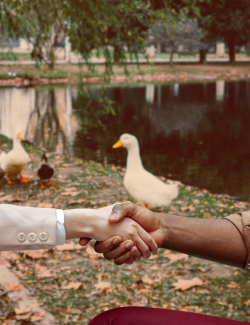
This prompts the customary response, even from someone as socially inept as my rider. “Ms. al-Haddad,” he says, “I’m Anselm Beuys.” He offers her his hand, and she delicately, tremblingly takes it. His fingers are meaty and chafed.
“We are behind schedule,” I say. Really, he must read Austen.
“But…” he sputters.
She purses her lips. At a 78% probability she is hiding amusement. “Your Shaw seems quite insistent,” she says, and nods a farewell, her gaze lingering. “It was a pleasure to meet you, Anselm.”
I begin wheeling him away. “I will see you…” He calls over his shoulder. “I will see you around?”
He doesn’t witness Yasmin’s wistful smile, but her Auxilion shares it with me as we exchange schedules for the week ahead. (Courtship matrix: incremented; encouragement functions: updated. Results shared with healthnet.)
“Chair,” Anselm says once we are out of earshot, “that was needlessly rude.”
“Playing Beatles: ‘Hey Jude,’” I reply.
My human groans, but doesn’t tell me to stop, and a minute later he is humming along.

About the Author:
Tom Allen grew up along the Iowa River at the edge of the Great Plains. After receiving a degree in physics, he wandered up the Mississippi to Minneapolis. A gay man living in recovery from addiction, he writes predominantly queer science fiction dealing with themes of collapse and transformation.