Posted on Leave a comment

The Last Page is Always Warm

An Acorns Flash Fiction Feature

By: Khayelihle Benghu

The Last Page Is Always Warm

The first time Miriam noticed the warmth, she thought it was the radiator.

It was early October, in the late hours of the afternoon, when the library grew hollow and echoing. The old pipes beneath the floor ticked and complained like tired bones. She had been re-shelving returns in the history aisle where the spines were old and some darker, the fonts more ancient. When she pulled a paperback from the drop cart, she felt heat against her palm, not body heat, no, not quite.

The book was warm the way a mug might be warm long after the tea inside has gone cold.

She held it there, confused, before checking the cover.

The Long Watch, by Arthur Bell. No dust jacket and slight curl at the corners. The library stamp inside was faded, as if impressed decades ago. She pressed her thumb to the pages and found them still warm.

Miriam looked around, half-expecting a prank, but the aisle was empty. The overhead lights hummed and the windows showed only her own reflection, thin and pale, framed by shelves.

She set the book aside and finished her shift.

The book must have embedded into her subconscious. That night, she dreamed that inside the library, the pages were live and they scanned her fingerprint.

The next afternoon, the book was back in the returns cart.

Miriam frowned. She was meticulous, had always been. She remembered placing The Long Watch on the shelf between two anthologies. However, here it was again, spine scuffed, pages faintly warm.

This time, curiosity overcame her caution. She slipped it into her bag at the end of the day and checked it out under her own name.

At home, she placed it on the kitchen table and let it sit while she made soup. The steam rose and the windows fogged. Still, when she returned and touched the book, it was warm in a way that did not belong to rooms or weather.

She opened to the first page.

The prose was spare, almost old-fashioned. A man standing watch in a lighthouse and the sea restless. The isolation familiar, Miriam read a few pages and then paused.

There was a line she did not remember from the first paragraph.

He thinks of the sound his wife made when she slipped on the rocks.

Miriam read it again and her throat tightened, becoming dry as if something was lodged inside it.

Arthur Bell’s wife had died that way. It was a minor detail mentioned in an obituary she had read years ago when cataloguing local authors. A coincidence, she told herself. Writers borrowed from life all the time.

She turned another page. The book was warmer now.

Miriam began to notice changes, sentences shifting and details deepening. Passages that felt less written than remembered. The lighthouse keeper began to think thoughts Miriam herself had once tried to forget: the hospital room with its too-clean smell, the way her mother’s hand had gone slack mid-squeeze, the silence afterward that felt heavier than grief.

She closed the book, her heart racing.

The warmth lingered on her fingertips.

For two days, she avoided it. She returned to work, catalogued donations, and answered patron questions. Almost pretended not to notice how often people paused in the history aisle, touching spines as if testing with their fingers.

On the third night, she opened the book again.

This time, the lighthouse keeper was no longer alone.

There was someone standing just beyond the reach of the light. Someone familiar, maybe someone he loved and had lost. The prose did not describe the face directly, but Miriam knew it anyway.

Her mother’s face, as it had been before the illness. Miriam slammed the book shut.

The cover was hot now –unmistakably so. She dropped it onto the table, breath shallow and pulse loud in her ears. She did not sleep that night. The following week, a patron approached the desk holding The Long Watch.

“Excuse me,” the woman said, eyes twinkling. “Is this new?”

Miriam stared. “No,” she said too quickly. “It’s old stock.”

“It feels alive,” the woman whispered, almost apologetically. “I’ve never read anything like it.”

Miriam swallowed hard. “I’m afraid it’s… fragile,” she said. “We’ll need to keep it in the archives.”

She took the book with careful hands. It was warm again, even through her sleeves.

That night, she locked it in the back room, inside the metal cabinet reserved for rare and damaged items. She told herself this was enough. That stories, however strange, were only stories. However, warmth is patient.

Miriam began to notice patrons lingering longer in the back room when she fetched holds. Fingers brushing the shelves and their eyes unfocused. One man stood too close to the cabinet once, breathing shallowly, as if listening for something inside.

She moved the book again. Wrapped it in archival paper. Placed it in a locked drawer within the cabinet, but the warmth seeped through anyway.

Feeling almost haunted, she dreamed of pages turning themselves. Hands reaching out from margins, of a lighthouse whose beam swept not over water but over memories, illuminating moments she had buried. The arguments left unresolved, words unsaid and the particular way grief could feel like being watched. When she woke, her palms were warm. Miriam tried to research Arthur Bell, but records were scarce. His biography was thin, contradictory, and one note in an old newspaper mentioned that the final manuscript of The Long Watch had been unfinished at his death, discovered among his papers with “no clear ending.”

She checked the library copy.

There was now an ending.

The lighthouse keeper, aged and tired, stood before the light for the final time. The warmth was unbearable. The presence behind him no longer waited in shadow. It stepped forward, and the prose grew intimate, tender.

He understands now that someone must remain.

Miriam felt a pressure behind her eyes.

The final paragraph was written in a hand that felt uncomfortably close to her own thoughts.

The watch does not end. It is passed.

She closed the book slowly.

It was hotter than she could comfortably hold. She considered destroying it. Fire would do, she thought. Or water. She imagined the book sinking into the river, pages bloating, ink bleeding away. However, the warmth felt almost pleading now. Not malicious, no, not exactly. But lonely.

That night, the power went out at her apartment. Darkness pooled in corners. She lit a candle and sat at the table, the book between her hands.

Her mother’s voice came to her, not as sound, but as presence, familiar warmth. The ache of connection.

Miriam felt aggrieved and wept. Not loud but in silence. She let herself read—the final pages had expanded again.

They spoke not of the lighthouse keeper but of a woman in a quiet building full of books. A watcher. A caretaker, someone who noticed what others passed by. Someone who listened.

The warmth grew steady, no longer threatening, but expectant.

The next morning, Miriam returned The Long Watch to the history aisle.

She did not stamp it. Did not catalogue the changes. She slid it into place and stepped back.

A young man reached for it moments later, eyes widening at the touch.

Miriam watched him go, heart heavy and calm all at once.

At the end of her shift, she noticed something strange.

Her hands were no longer cold.

Over the weeks that followed, the library felt different to her. It felt fuller and charged. She sensed stories breathing behind their covers and seemingly waiting. She began to linger after hours, walking the aisles, touching spines, feeling warmth bloom and fade.

Sometimes, when she paused long enough, she felt memories stir hers, others indistinguishable and some human. She understood now.

The watch does not end. It is passed, and the last page, she learned, is always warm.

About the Author:

Khayelihle Benghu is an emerging author residing in Johannesburg, South Africa. Except writing she has a heart for photography, mainly nature.

Posted on Leave a comment

Tuberculus Mom

An Acorns Flash Fiction Feature

By: Mario Senzale

I was assigned to Brother Kartoffel right after growth season. Some got hunting. Others, construction. I got planting.

“You’re strong,” the elder said, looking me over. “Good build. You’ll do fine with the mothers.”

I knew what that meant. Everyone did. The rooting ceremony. The mothers go down, they feed the earth, the earth feeds them, and the young ones come up stout.

On the first day, Brother Kartoffel showed me how to dig the beds. Six feet down, four feet wide. The soil in the north fields is perfect for it—dark, moist, full of nutrients.

“Make it cozy, Brother Arnut” he said. “They’ll be here for a while.”

“How long?” I asked.

“Six months. Sometimes seven if the young one’s stubborn.”

We dug four beds that week. Sister Wortel, Sister Rote, Sister Ube, and Sister Neep. The ceremony was on Sunday. The whole commune came out. Drums, singings, the elders blessing the soil. Sister Ube went first. Six months along, her middle huge and low. She walked to the field wearing nothing. Smiling. Covered in compost and manure. The women had prepared her since dawn, layering her in the mixture. She spread her arms to the crowd.

“This is my gift. My body for the earth. My young one for the future.”

Everyone cheered. Brother Kartoffel and I helped her into the bed. She lay down, still smiling, hands on her swollen middle. The compost was packed around her, thick and warm. Her face was the last thing visible.

“See you at harvest,” she said.

We covered her. The soil went on easy, and the women sang. When we were done, Brother Kartoffel hammered the stake into the ground. “Sister Ube—3/17.”

Sister Wortel came after, followed by Sister Rote and Sister Neep. All of them smiling. All of them honored. The ceremonies were always the same. Joyful. At night there was a feast. The whole commune celebrated the new plantings. Brother Kartoffel got loose on Kombucha and told stories about harvests from when he was young.

“You’ll see, Brother Arnut,” he said, his arm around me. “When they come up, it’s magic. Magic. And we—we have the front seat.”

“What do they look like, Brother Kartoffel? What do they look like?”

“Reborn, Brother Arnut. Reborn.”

“And the young ones, Brother Kartoffel? The young ones?”

“You’ll see, Brother Arnut. You’ll see.” He smiled.

I went home late. The light was fading. I drank water, lots of it, and stood in my yard for a while, feeling the start of spring.

Three months in, the soil above the beds started swelling. Rising up like bread. Brother Kartoffel said that was normal. It meant the mothers were growing.

“The seedling feeds them through the cord. Gives them what they need to survive. Nutrients, minerals. Keeps them strong.”

“So they’re alive?”

“More than alive. They’re becoming!”

One morning I was checking the irrigation system and heard something coming from Sister Wortel’s bedding. A hum. Low and steady. I knelt down and pressed close to the soil. Slow and thick. A heartbeat.

“Beautiful, isn’t it?” Brother Kartoffel said behind me. I jumped.

“I was just—”

“It’s ok, Brother Arnut. I do it too. I like to check on them. Make sure they’re happy.”

He knelt down beside me and listened. The sun felt good. Necessary.

By month five, all four beds had swollen significantly. The ground was raised a foot. Maybe more. You could see the shape of the mothers underneath. Round. Dense. Like huge tubers pushing up from below. The commune was preparing for harvest. Building the platforms, sharpening the tools, organizing the feast. It was the biggest celebration of the year.

9/24. Harvest day. The whole commune gathered at dawn. Drums, singings, the elders blessing the tools. Brother Kartoffel and I started digging. Carefully. The soil came up easy, loose and rich.

“There she is!” Brother Kartoffel said, grinning.

 We dug around it carefully, exposing the shape. It was huge. Four feet across. We kept digging until we could see the whole thing. Sister Rote. Her body had fused into a single swollen mass. No arms, no legs. Just a thick, oval shape with her face barely visible on one end. The crowd cheered.

“She’s perfect!” A young girl yelled.

We used ropes to pull her up. It took six of us. She was heavy, dense as clay. When we finally got her to the surface, everyone pressed forward to see. Her skin had a waxy sheen. Her eyes were closed. Peaceful. Her mouth was slightly open, and you could see roots inside. Thin, white, threading through her teeth. She was breathing. Slow. Steady. The elder stepped forward and placed his hand on her.

“Sister Rote. Your becoming honors us!”

Then the skin split. Not violently. It just opened. Like a pod. The flesh peeling back in sections, revealing dark, rich soil inside. And in the center, wrapped in pale roots, something small. It was deep red, almost purple. Smooth. Round and tiny, with a face. Sleeping. Perfect. The elder lifted it out carefully. The roots detached with soft pops. He held it up to the crowd.

“Behold! New life!”

Everyone cheered. The young one opened its eyes. Magenta. Dark.

The thing that was Sister Rote lay on the platform, hollowed out. The elder nodded to us.

“Return her to the earth.”

We carried her back to the bed. Her body was lighter now, crumbling at the edges. We covered her up. Within minutes, she started to dissolve.

“She’ll feed us now,” Brother Kartoffel said. “One last time.”

We harvested the other three after that. Sister Wortel’s young one was a parsnip—pale and tapered, with a fierce little face. Brother Möhre had been expecting a carrot himself, but he held the baby parsnip with pride anyway. Sister Ube’s came out as a fingerling potato, long and knobby. Brother Kartoffel looked at the sky. “At least it’s starchy,” Brother Kand said. Sister Neep’s young one was the surprise. Wrinkly, brown, kind of hairy.

“A taro,” someone whispered.

Brother Rapa stared at the small child, its face already scrunching up, ready to cry its papery cry.

“My father will kill me,” he muttered.

At the feast, I sat next to Brother Kartoffel and watched the families with their new ones. The beet, the parsnip, the fingerling, the taro. They were already growing, little root-hairs searching for soil, faces turning toward the sun. Brother Möhre was teaching the parsnip to hold a spoon. Brother Rapa sat alone in the corner, the taro-child asleep in his arms.

“You did good, Brother Arnut,” Brother Kartoffel said. “You did good.”

“It wasn’t hard. Always a surprise.”

“I know, Brother Arnut. I know,” he replied, looking at the fingerling.

“Do they stay like that? The young ones?”

“For a while. Then they root somewhere, and a few years later, they’re like us. Walking. Talking. Strong.”

I looked across the field where the mothers had been returned to the soil.

“Next season, we plant six more,” Brother Kartoffel said. “You ready, Brother Arnut?”

I nodded. The drums started up again. The dancing. The celebration. And in the fields, the soil hummed softly. Waiting.

About the Author:

Mario Senzale is a South American writer and mathematician currently living in Indianapolis, Indiana.  Check out his work at mariosenzale.neocities.org, or follow him on BlueSky at @mariosenzale.bsky.social.

Posted on 1 Comment

Dragon Dancers

An Acorns Flash Fiction Feature

By: Karen McCullough

An hour before the start of the afternoon performance, Lia discovered Ocho was missing. The dragons had a back-up four-place dance in their repertoire, but none of them liked it. More participants produced better routines. And today’s shows had to be fabulous. Their survival depended on it.

She asked Doce about him as she prepared the banners.

“He heard a call.” The dragon stretched out his wings and dipped one toward her. Lia massaged the tissues between the long bones and Doce sighed. “If he doesn’t return in time, we’ll do the Quatrain.”

“He had to go now? How far?” She considered sending Doce after him, but when a dragon heard a call, the compulsion overrode most other considerations. No telling what might be the source. A mating call was the most common type, but the dragons’ emotional sensitivity meant Ocho could be responding to a cry for help or companionship, from others of his kind, from humans, or even less self-aware creatures. Cinco had once brought back three orphaned dragons. Of them, Doce and Quince had stayed with the troop while their brother went off to seek his own adventures.

Quince had twice issued mating calls herself and received plenty of attention, but so far no offspring had resulted. The troop needed more individuals. The five dragons did remarkable routines, but more participants could create yet more dramatic and spectacular aerial dances. With luck, Ocho would find others.

“He said he’d be back in time for the afternoon dance,” Doce said.

Lia rubbed her forehead. “He’d better be. This is the best booking we’ve had for months, and it’s only for two days.”

Doce lifted a shoulder in a dragon shrug.

She sometimes envied the dragons’ carefree attitude. Other times, like now, it annoyed her. Lia worried over everything—food, shelter, transportation, bookings, and the hundreds of other details of managing the shows and the dragons’ needs. The job had grown harder two months past, when her former partner told her he’d had enough, handed over the business, broke off their engagement, and disappeared into the morning mist, taking all their recent profits with him.

A man and child walked up, distracting her, and asked, “Are there still seats for the next show? I heard this morning’s was amazing.”

“There are.” She made out tickets for them. “Take these to the gate and please spread the word about tomorrows’ performances.”

The man hesitated. “Can I ask you about the dragons? How do you train them to dance so beautifully?”

“I don’t train them. I help them develop routines, but mostly they create their own, and they dance purely for the love of it. Some dragons are born to perform. They draw energy from the crowds that watch and cheer for them.”

“How do you find them or recruit them?”

She searched the horizons, hoping for a glimpse of Ocho. “They find me. They need a human partner to manage the practical details for them.”

“Why do you do it?”

“I—” No one had asked her that before and she had to think about it. “I love them, I guess. I have an affinity for them, and they seem to feel the same for me. I’m part of their world and love to watch them dance their joy.”

“Taking care of them and the shows must be a lot of work.”

“Organizing the shows can be hard. The dragons mostly take care of themselves. And sometimes they take care of me, too.”

“They do?”

“They’re very sensitive to emotions, human and dragon. They try to cheer me when I’m distraught and they protect against danger.”

He looked surprised, but the girl with him tugged on his arm and dragged him away.

She checked the time. Thirty minutes until the next show. The customer’s words reminded her what a stunning performance they’d put on that morning. In the sky overhead, the five dragons had looped and swirled graceful arabesques with sunlight glittering off their scales in cascades of green, blue, and silver. Children in the audience gaped in wonder, inspiring her to see it from their viewpoint. She took for granted the glorious spectacle of wings beating in rhythm: long slender bodies weaving fluid, twisting patterns; tails joining together or with their fellows’ heads to form ovals, stars, and florets; and the final eruption of the flame display. The dragons fed on the wonderment of their audience and elevated their performance.

She doubted this afternoon’s show would run so smoothly. Ocho was the oldest and most experienced of the crew. Without him the others might fumble their moves.

Everything could go sideways if he didn’t return before the next performance. A glance at the village clock tower showed twenty minutes remaining.

Her breath sped up. They needed another spectacular performance to ensure tomorrow’s crowd would be larger. Without Ocho, though…

Movement caught her eye off to the east. A cloud of dust approaching, possibly with a cart at its center. Above it, scales glinted in the sunlight. Dragons…Maybe three? Was that greenish-gold one Ocho?

After a quick debate, she went to the staging area and announced a short delay in getting started but promised the show would be worth the wait. Her identification had better be right.

The dragons arrived before the cart, with Ocho in the lead. She sighed with relief as she went to meet him and urged him to join the others in getting ready for the show.

“We will all join,” he announced. “This show will be the best.”

Surprise and doubt washed over her. She looked at the two new dragons “They don’t know the routines.”

“They do,” Ocho insisted. “I have demonstrated for them. And they will fit in. I’ll inform the others.”

She’d have to trust he knew what he was doing. Ocho generally did. But her nerves still jangled as she watched him fly off. Before she could hurry after him to the field, the cart arrived, driven by an attractive young man wearing a bashful look.

“You must be Lia,” he said. “Ocho told me to find you and offer my help. He heard a call from my dragons, but he said your heart had been calling, too, and I was the answer.”

“Not sure what that means,” she answered. “But the show’s about to get started and I can’t worry about it now.”

She heard him follow her to the field, but he waited at the side while she announced the introduction. The nervous lump in her throat made it harder to project, but she got through her spiel and cued the dragons to begin. The newcomer joined her once she moved aside while the dragons glided onto the field, one after the other, in a rippling ribbon of graceful curves and glittering scales.

She held her breath as they rose into the air and began weaving the complex tapestry of fluctuating formations. Moments later she released the air on a gasp. Ocho hadn’t exaggerated. The newcomers fit themselves into the routines perfectly, the larger number making their flowing spirals and whirling pirouettes yet more spectacular.

The young man next to her jerked in a sharp breath and let it out slowly. “They’re beautiful. It’s amazing. I didn’t know they could do this.”

“They are. Ocho was right about them fitting in. He’s right about a lot of things.”

The dragons launched into their fiery concluding routine, emitting undulating, interweaving, and brilliantly colored columns of flame high above, drawing thunderous applause from the crowd.

The young man’s eyes lit as he stared at her. He leaned closer to make himself heard over the noise. “I’m Geoffrey, by the way, and this is the most amazing day of my life. I hope you’ll let me join your troupe along with my dragons.”

“I don’t think I could stop you.” She smiled at him, eyeing his broad shoulders, slender waist, and pleasant features. “I don’t think I want to.”

About the Author:

Karen McCullough is the author of more than two dozen published novels and novellas in the mystery, romance, suspense, and fantasy genres, including the Market Center Mysteries Series and three books in the No Brides Club series. A member of Mystery Writers of America, Sisters in Crime, and the Short Mystery Fiction Society, she is also a past president of the Southeast chapter of Mystery Writers of America and served on the MWA national board as well as the boards of two Romance Writers of America chapters. Karen has won numerous awards, including the 2021 Bould Awards for flash fiction, an Epic Ebook Award for fantasy, and has also been a finalist in the Daphne, Prism, Dream Realm, International Digital, Lories, and Vixen Award contests. Her short fiction has appeared in a wide variety of anthologies. More information is available at her website: https://www.kmccullough.com.

Posted on

What a Toad Buys You

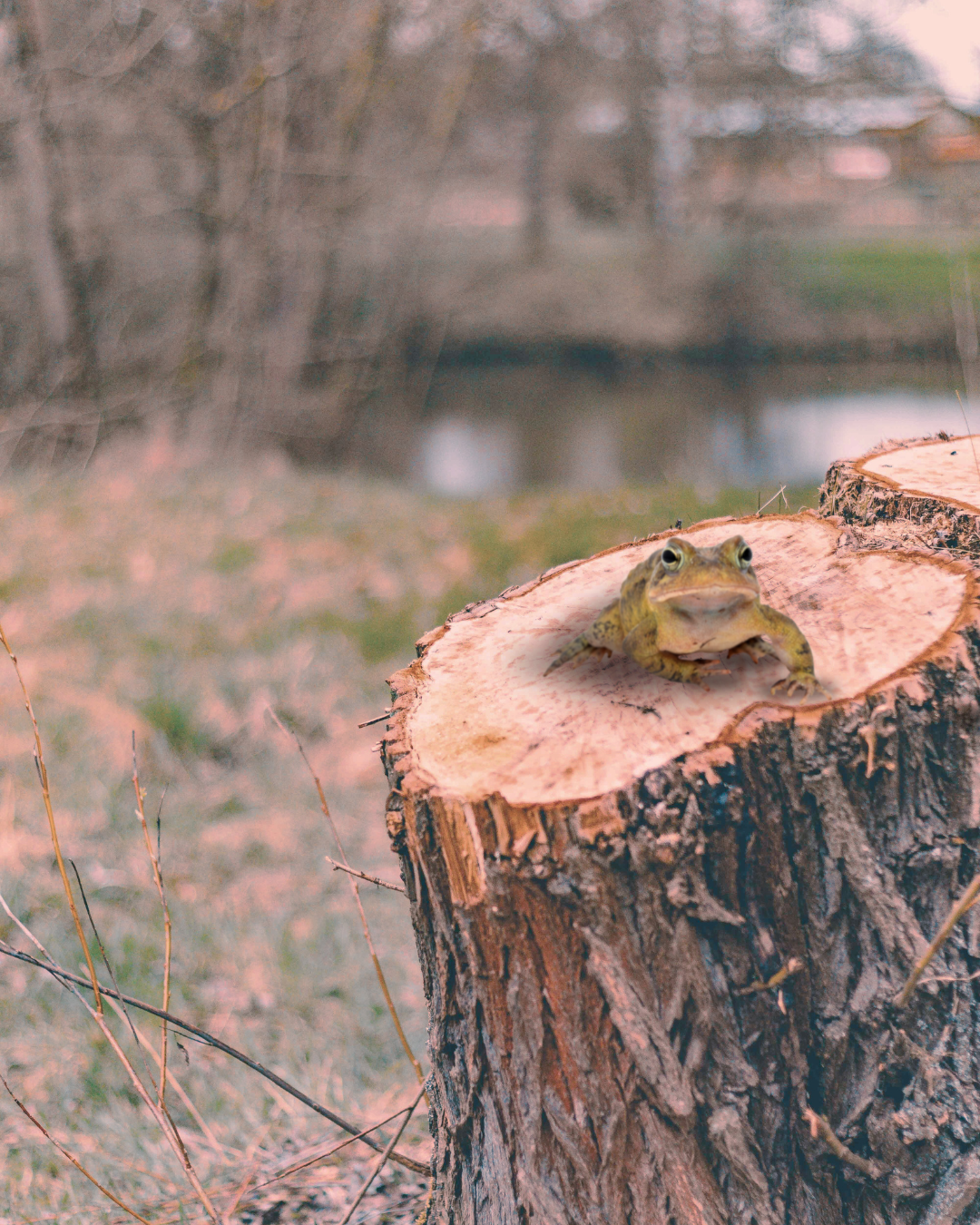
A toad sitting on a stump at the edge of a forest

An Acorns Flash Fiction Feature

By: James Hobbs

The toad squirmed in my pocket as I knocked on the witch’s door. Her name was Granny Hexham, an old, withered woman, so hunched that her body was practically a hoop. She couldn’t move around too fast, so there was a lot of grumbling, banging, grunting, and growling before the door creaked open. Her watery eyes squinted at me as she scratched one of the hairy warts on her cheek with a long, moldy, yellow fingernail.

“Well, well, well, well, sweet, little boy, did you bring my fee?”

I was too scared to speak, so I just nodded, reached into my pocket, and held out the bundle I’d made from my handkerchief. You could see the toad inside kick and struggle as Granny Hexham brought it to her nose, almost as lean and crooked as her body, and took a long sniff.

She licked her skinny lips and hissed, “Yes, yes, sweet boy, this’ll do nicely.”

She ushered me into her crooked little cottage and hurried me to sit on a stool. It was dark except for the needles of light that poked through the gaps in the crooked boards of the walls. Then knotty fingers unwrapped the bundle, grabbed the toad by the leg before it could hop away, and slammed its head against the table until it stopped trying to escape. Then she took stock of the rest of her payment: a blue-shelled beetle; two small green apples; six hairs from the tail of a three-legged dog; and a small stone I’d kept in my shoe for three days and three nights.

“So, little man, you wanted someone cursed.”

“My new school teacher, Mr. Cospwattle. He yells at me all the time, when I can’t do my ciphering or forget my grammar lessons.”

She nodded, a look of exaggerated sadness twisting her wrinkled face. “A dreadful shame to be so cruel to such a dear, young child.”

She pulled a dented frying pan off the wall, tossed a pat of butter into it, lit a fire in her stove, and started frying up the toad with a pinch of salt and pepper.

“I…I don’t want you to kill him or turn him into a worm or anything. I just need you to chase him away, so they have to get a new teacher.”

Granny Hexham cackled to herself as she tossed the toad in the pan. “Yes, yes, yes, yes, I know many spells to vex him.” She flipped the toad onto a plate and started frying some eggs to go with it. “I can make it so that every time a Thursday falls on the seventh day of the month, if he wears black or green, a sparrow will drop its dung on his shoulder. I can cast a spell that will make his left wrist tickle perniciously before it snows. I can make him unable to spell the word ‘social.’ I can cause him to drop his favorite mug, so that it shatters into a thousand pieces, as long as that mug doesn’t have diagonal stripes on it. Do any of these little tricks strike your fancy, hmm?”

“Umm…” To see Granny Hexham, I had braved the dark forest, which my parents had told me in no uncertain terms never to enter. “Is there anything else you can do?”

She whirled around and glared at me. “I have other curses, little man. I can make him sneeze any time he meets the eyes of a two-year-old hog. If he has a fondness for fruit, I can cause pears to taste like slightly rotten apples. If that is not cruel enough for you, I can cause the knot of his favorite cravat to come untied twice as often as usual. Are any of these wicked enough for you?”

“Well…”

I have never in my life seen anyone take fried eggs from a pan with so much malice. She slammed her plate onto the table across from me and grabbed a two-tined fork so long I was afraid she’d skewer me with it, not her supper.

“Ungrateful boy. Don’t be so choosy. I haven’t tasted toad and eggs in a long time. I would rather eat them in peace.”

“Those curses are all really very wicked, but I thought—”

She stabbed the toad and bit off its head so forcefully that I shut my mouth with a snap.

After the lump of chewed toad made its way down her skinny throat, she licked her lips and said, her voice suddenly less hissing and mysterious, “Listen, I don’t know what you expect to get for a toad and a few measly trinkets. If you want better curses, you can go see another witch, but I can promise you nobody’ll cast a curse for cheaper than me.”

“But I’ve heard all about you. They said you were the wickedest witch this side of Glarmsby.”

She sighed and hunched over so far that her long nose almost dipped into the runny yolks of her eggs. “I was, little man. I was, but that was many years ago. In my prime, I could’ve had your teacher’s house eaten by termites or struck by lightning or given him the old yalping cough; howling aches; and the foul fustian flux. I could’ve filled his bed with hedgepigs and his breadbox with bog worms. I’d vex him. I’d well and truly addle him.” Then her voice rose and her jowls shook with anger. “But I’d like to see you do a better job of casting a curse when you’re a hundred and two, and your eyes don’t work, your back aches, and you set things down one minute and can’t remember where you left them the next. And for only the price of a toad.”

I wasn’t quite sure how to respond to her sudden outburst, so I fidgeted with the buttons on my coat and said, “What if I brought you another toad? Could you cast two curses for me?”

“Another toad, another stone from your shoe, and a fly’s left wing.”

I didn’t like the idea of walking around with an uncomfortable stone in my shoe for three more days, and flies are hard to catch, so I said, “My mom’s tomatoes are ripe. I can pick a couple of those to eat with your toad and eggs.”

She took another bite of toad and chewed thoughtfully for a minute, before saying, “You’ve got a bargain.”

So I went home and stole two oblong tomatoes and scoured the forest and splashed around until I had caught another toad and tied it up in my handkerchief. She told me she cast curses on Mr. Cospwattle that made his leg itch whenever he ate peas and that gave him a splitting headache in the morning of any day in October when a bird had sat on the roof of the schoolhouse the previous night. I guess it worked. I think I noticed Mr. Cospwattle scratching his leg sometimes as he ate his lunch out of a tin pail, and he did seem especially irritable in October from then on, but it didn’t drive him away. I doubt he noticed anything had changed. Finally, he got offered a better paying job teaching in the city and left. As for me, I never made another bargain with a witch. As far as I can tell, it’s not worth the trouble.

About the author:

Originally from Kansas City, Missouri, James Hobbs is currently a PhD student at the university of York, studying early modern history. He writes as a hobby in between doing research.

Posted on

Of Lost Boys and Stars and Sharks and Other Impossible Things

An Acorns Flash Fiction Feature

By: Alyson Tait

From low tide of the pirate cove all the way back to our camp, me and Peter ran, ignoring everything except each other and the traps we’d set because those weren’t for us. They were for grown-ups and other beasts: bear traps, swinging nets, and hidden pits with sticks we’d spent weeks sharpening. We didn’t stop until we reached our home tree. Staccato laughter punctuated gasps of air.

Peter boosted me, my foot pushing off his hands so I could grab a branch and climb. He jumped as if he weighed nothing and beat me to the top where we lay next to each other on thick branches and planks of wood, gulping air.

When we could breathe again, he turned to me, grinning. “They thought—” The rest of his sentence vanished beneath roaring laughter.

It’s impossible to know how long we stayed there laughing, catching our breaths, and talking in half-finished sentences about the raid on the pirates. The only marker of time was the sun disappearing, and in its place, the moon arrived, bringing friends with it. A hundred thousand million stars, and those were just the visible ones.

I asked Peter how many stars he thought there were. “Not just the obvious ones. How many total in all the universe?”

He shrugged. “Who cares? Wendy, you should leave that kinda stuff to the philosophers.” He stood and climbed down the tree, whistling a tune as if he didn’t have a care in the world.

And really, he didn’t. It was the best thing about him.

He didn’t care that he’d lost when we played cards that night, numbers barely visible in the moonlight—even when I’d played the queen of hearts. He never cared. Maybe because he never got tired, injured, or lost anything of great importance.

Sometimes, I wondered if he considered me of great importance. Was I worth him getting upset about? Would he grab that play sword of his and swing it at a pirate? Or a canyon if I fell in?

I almost asked but I knew what he’d say. The same thing he always said about questions like where the other kids were, how many stars there were, or why we never grew.

Leave it to the philosophers.

I didn’t need the philosophers for that one though—I just wanted his attention.

When dawn came, he didn’t sleep. Instead, he suggested we go swimming after breakfast.

The sun was bright overhead when our toes dipped into the water. I sat on the sand, nursing a stitch that pinched at my side because we’d traveled from one end of the island to the other with no dreams in between.

“The water’s warm!” Peter sang—taunted—from chest-deep in the lagoon.

“The water’s always warm!” I yelled back.

He shook his head. I could hear his thoughts. “Stop thinking so much.”

“So swim with me,” he said instead and grinned.

There was never any arguing with him, and I didn’t want to, I liked him too much.

So I swam.

We splashed and called out for the mermaids that liked to play sometimes and ignored everything else until my arms got tired and heavy.  When I was halfway to the shore, Peter yelled. I assumed it was about me leaving his game, but something sharp scraped against my leg.

I picked up my pace.

The sharpness came again. A thin burning pain ripped across my calf from some wayward shark that’d ventured into the shallower water.

My fatigue drained away—my tiredness vanished as if it had never even been there.

Water splashed behind me, and impossibly, my aching arms pumped faster despite my lungs burning from the effort until I was safe on land.

“Peter!” I screamed, voice cracking.

I didn’t see him anywhere. Not a limb, finger, or single strand of hair.

The water went still.

I held my breath.

“Come up.” My heart thundered in my ears.

Panic came in waves. My vision went dark at the edges.

I’d escaped. Was it because the shark had feasted on Peter instead?

That meant my guide—my best friend—was gone.

A choking sob left my throat.  “What do I do?” The thought was unfinished, swept out to sea with my heart and lungs.

Only the wind moved.

“Always so many questions, Wendy,” a laughing voice said behind me.

A startled scream tore out of me before I turned.

There he was.

My chest tightened and he grinned, as if the ocean hadn’t just threatened to take us away from each other. I slapped his arm for always scaring me.

His grin widened. “Too many questions, actually. Save some for the—”

“Maybe I’m the philosopher!” I said although I wasn’t sure what it meant. Not really.

I wanted to push him back into the water so he could feel fear too.

But then Peter laughed, and just like always, the sound took all my anger away.

When he caught his breath, we ran.

I ignored the scrape in my leg, and we ran all the way from the lagoon back to our tree. We didn’t slow down, not even to take a breath or watch the beasts that ran by. We tagged each other’s shoulders anytime the other got too far ahead, and both of us jumped over hidden pits, and we veered around the traps along the way so we didn’t get hurt because injuries meant less adventures—the worst possible thing to happen on Peter’s island.

When we reached the tree again, we flopped onto the grass, Peter laughing like always while I watched the sky. Clear, blue, and endless, like the ocean had been flipped upside down above us.

How many days of careless running did we have left? I glanced over, catching him staring at me with a grin. Maybe he was right. Maybe I didn’t need all the answers if I could still run with him, and maybe I should leave all those hard questions to the grown-ups.

And so with a grin, I decided I would.

About the author:

Alyson Tait was born and raised in the Southwest USA, where she walked alongside cactuses and scorpions before moving to Maryland. She now lives among the crabs with her partner, daughter, and multiple judgmental pets. She has appeared in (mac)ro(mic), HAD, and Pseudopod. She has chapbooks published by Querencia Press, Bottlecap Press, and Fahmidan Publishing, one book forthcoming with Graveside Press, and several novellas on Amazon.

Posted on

The Last Time I Saw You

An Acorns Flash Fiction Feature

By: Jake Stein

I called him by the waterfront, where the black river reminded me what I loved about the city and hated about the world. “I’m sorry for doing… what I did,” I said, between vaping my chemicals.

(Yeah, they were the bad kind of chems, but not the really bad kind.)

“Relax about it,” Beo said over the phone—always over the phone these days. “Nothing to apologize for.” And I could hear his wolfish grin, almost see it.

Almost.

I walked through the night alongside restless waters, puffing clouds. I chose not to check the reflection of my new haircut in a passing store window. “Well, just know… I won’t ever say those magic words again.”

“Never?” Beo sounded disappointed. “It’s not bad for me, at least.”

The spotlight of a streetlamp crawled past on the sidewalk, and I gazed down at the fading “X” on my wrist—an entry stamp from the last time Beo was in town, when I went to see his karate competition. But I couldn’t stare at that “X” on my skin, couldn’t think about what it meant, or I’d start crying again. “I just hate being this far away. I miss your face, and your hair. All of your hair—”

Ahead, someone stepped out of the shadows.

“Speaking of hair,” said this big stranger, who was attempting to block my path, “I really like yours.”

First off, I’m quick. You better believe I skirted around him, no problem.

Keep walking, keep walking.

But his footsteps grew louder. He was coming after me.

“Something wrong?” asked Beo, still on the line.

“Same old crap,” I muttered, picking up my pace. A glance over my shoulder told me Mr. Creep was fully giving chase, barreling through a cloud of his own chems—which, judging by the smell, were the reallybad kind.

“Get out of there,” Beo said, but I was already running.

“Didn’t you hear me?” the creeper called after me. “I love your hair! Can’t you take a compliment?”

Inhaling my chems, I turned onto a main street and waved down a cop, but he drove past. Probably figured there was no point in wasting his time on some chemmed-out low-life.

“Hey you!” This asshole was whistling and everything. “Don’t even turn around, I love how you look when you’re running away!”

Beo was panicking in my ear. “Talk to me. What’s going on?”

I didn’t answer, too focused on escaping this lunatic. Tearing along the waterfront, through an intersection, cars honking. No matter how much I tuned out the shouting behind me, I couldn’t tune out the footsteps, getting closer…

From thousands of miles away, Beo said, “The magic words. Say the magic words!”

I knew he was right, but as I swung around a corner, I blurted, “I can’t. It hurts me.”

“Hurts?”

“I mean, to only see you for…” But I was lost now, shooting through dark alleys, the kind where people don’t exist, only echoing sounds like the sound of the creep gaining on me.

He called out, “Don’t make me hurt you!”

And yeah, that was it. I took Beo’s suggestion.

Spinning on my heels, I dragged my chems, filling every little pocket inside me with sweet vapor—and released the cloud in my pursuer’s direction. In that split-second I felt like a dragon; I felt amazing. For once.

Before he even knew what hit him—or should I say, who—I spoke the words. The incantation I’d stumbled upon; the spell which was, I hoped, about to save my life.

The voice which fell from my lips was not my own, but the voice of a thousand sorrows, the not-sound before a car crash.

“I don’t want to call you my ex.

For a second, reality refused to break. My cloud merely floated past my assailant, dissipating around him. No spell.

Backpedaling, I found myself up against a wall. This alley was a dead-end.

The big guy was close enough that I could smell his wheezing dumpster-breath. He had that chemmed-out look of a festered turd with raggy skin, and his bloodshot eyes were crawling all over me. “Don’t wanna call me your ex, huh? That’s skipping a few steps. I haven’t even told you I love you yet…” But he trailed off, glancing over his shoulder.

My exhaled cloud was reappearing, expanding to fill the alley like fog. From those vapors a shape emerged, taking humanoid form. The eyes appeared first, yellow and leering. Then came the snout, the ears, the whiskers. The lean-muscular body covered in hair. He was standing on two legs, tail whipping angrily, drool hanging from snarling lips. He looked even more like a monster than usual.

My monster.

“What the—” And that’s all this creep could say, as Beo emerged from the mist.

I don’t think it would have taken more than two punches, but Beo gave him three. Beo, the wolfman I’d met in a different city where we both used to live. The black belt who’d been waiting for this moment his entire life.

I didn’t blame him for taking the third swing.

It was enough to send the creep off with a limp and a trail of blood. Darkness swallowed him, and in that instant it was like he’d never existed. A passing shadow of a night which could have gone so much worse… a night which would probably never leave me. But I would pretend—until arriving home, locking the door behind me, and stepping into a hot shower—that this attack had been nothing more than a nightmare, no more real than this version of Beo standing before me.

Beo’s mist-copy turned and smiled, massaging his fist. “Funny, it stings like I’m actually there.”

“Thank you,” I managed, and that was all. My throat knotted with tears. Looking at the doppelganger of my boyfriend was like poking a raw wound inside me.

Always hurts to see someone you love when you know they’re about to disappear.

Indeed, Beo’s cloud was already beginning to fade. It never lasted long. “Hey, don’t cry,” he said, even as he evaporated. “I’m gonna call you right back, okay? This won’t be the last time I see you.” And his vicarious presence wrapped his arms around me.

But I felt no embrace, only condensation.

“I do these chemicals to fill the space between us,” I said suddenly, shocked by the truth of it.

“We are too far away, I agree.” His voice was becoming quieter, quieter. “But I can’t afford to move out there, and with your mom, you can’t come out here…” And the cloud finally dispersed, those last wet tendrils of my breath-spell slinking away.

Eventually I found the river again and followed it. Beneath a streetlamp I studied my hand, trying to find the “X.” But the ink seemed to have completely faded now, like my chem vapors had washed the stamp away.

Beo called me, but I didn’t answer. I was thinking about how he hadn’t mentioned my haircut. Maybe hadn’t noticed.

I took another hit of my chemicals, the bad kind, and kept walking.

About the author:

Jake Stein’s work has appeared or is forthcoming in Lightspeed Magazine, Ellery Queen Mystery Magazine, and Aurealis.

Posted on

Introducing Hollow Oak: Our First Chapter

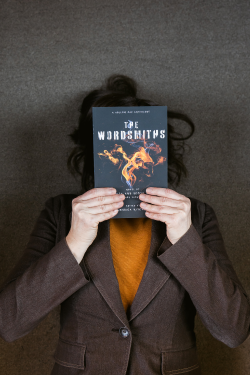
Woman wearing an orange shirt and a brown blazer lying on the floor, holding a speculative fiction anthology book called The Wordsmiths in front of her face

Welcome readers and writers and everyone in-between! I’m Amanda, the founder and editor-in-chief of Hollow Oak Press, and I’m addicted to what-ifs.

I’ve always liked stories, and being creative is as much a part of me as my left arm. The rush of a story idea, when that character or situation crosses into a new what-if scenario? There’s little that can match it.

I haven’t always known that about myself, though. I lived a big portion of my adult life creating nothing at all. I’d thrown myself headfirst into graduate school and then into my non-creative career, and I let that work consume me. I helped other people learn how to solve problems and to heal their relationships, and I pretended that work fed my energy, but really, it drained me. I used the sunk-cost fallacy as motivation to work harder and climb higher on a ladder where my feet never quite felt comfortable on the rungs. When I eventually paused to take in the view, I realized I didn’t want to go any higher. I didn’t particularly want to be on that ladder at all.

So I jumped. I threw myself into creative hobbies like community theater and this wonderful scavenger hunt called GISH (ask me about it, but only if you have an hour to listen to me sing its praises and show you photos). Being creative scratched an itch I didn’t realize I’d had. I wanted more and more and more.

And then, I bought a Chromebook and picked up something I hadn’t done in far too many years. I began writing again.

Flash-forward a couple of years to a chilly late fall evening, when my dog and I were out for a walk. I’d dedicated the previous year to the chase of traditional publishing and the heartache of querying agents with a novel. The online writing communities had called out “self-publish!” and I’d gotten DMs and emails from sleazy vanity presses trying to siphon money out of me. I’d also gotten back into writing short stories, my first love, and had a couple pieces accepted amongst easily a hundred rejections. I’d been watching online literary magazines and learning what markets existed for short fiction. The sheer number of plucky little publications that couldn’t afford to pay their authors dizzied me.

Mostly though, I was taken aback by the juxtaposition between the wealth-fueled Goliath of traditional publishing and the penny-scraping idealism of independent publishing, and it’s that very thing I ruminated on while on our daily constitutional.

My dog and I crunched through the leaves on the ground and the duskiness of the evening seeped into my very being. Dawn and dusk, two liminal times of day, straddling what is and what will be. I filled my lungs with the kind of autumn air that’s tinged with the promise of winter and steeled myself for a thought that had been trying to form itself for weeks.

What if I could provide a platform for authors like me?

What if I started a publishing company?

Now, three years later, I’ve taken that what-if and made it a reality. At Hollow Oak Press, we stand at a publishing crossroads. We’re a scrappy indie publishing company, and we believe that new and emerging voices in fiction have entertaining and impactful stories to tell. We want to help those authors find their readers. Details about our submission process can be found here.

We publish anthologies that immerse a reader beyond the story’s words. Our titles are available directly from us, from major online retailers, and select independent bookstores.