An Acorns Flash Fiction Feature
By: Fija Callaghan
Old Mrs Iles first came across the house when she was out gathering moss to line her garden stones. Her own home had been awfully quiet since Mr Iles ran off with New Mrs Iles, and so Old Mrs Iles often went for walks in the woods behind the property.
The forest was a bright young thing, all adolescent saplings spaced a respectable distance apart so they could grow big and strong. Even the brambles and ivy behaved themselves, most of the time. So when Old Mrs Iles discovered a ramshackle stone cottage not much bigger than a garden shed, with a pair of scaly chicken feet sticking out from underneath, the most reasonable thing seemed to be to go inside and see what it was about.
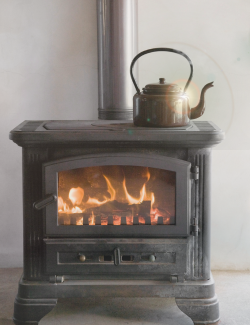
The house seemed bigger on the inside than it did on the outside, but not much bigger, not like a magic trick. Just big enough to while away a pleasant afternoon. There was a cold woodstove and a kettle, a small table with two off-kilter chairs, a lumpy mat piled high with blankets, a narrow broom cupboard propped against one side, and a dusty, meaty smell like someone had eaten stew there a long time ago. Old Mrs Iles thought that actually, it was quite homey. So she did a little dusting and cleaned off the single windowpane so she could see outside.
By the time night fell, nobody had returned to the house. So Old Mrs Iles thought oh well, I’ll just rest for a few minutes. The truth was, she still wasn’t used to coming home to a place that didn’t have Mr Iles in it.
Old Mrs Iles lit a fire in the woodstove, laid down on the lumpy mat, and was out like a light.
When she woke she wasn’t sure where she was, but she knew the air was salty and sweet, and she was more well rested than she’d been in a long time. She could hear gulls crying. Outside the window was a broad, sparkling expanse of bright blue sea.
Her heart swelled with longing and joy. She hadn’t seen the sea in more than fifty years.
A quick look in the broom cupboard revealed a neatly folded fishing net. Old Mrs Iles took it outside to catch some fish for her breakfast. She stood right in the water in her bare feet, with her trousers rolled up to her knees, and laughed like she was a young girl.
That night she lay down in the little house again and wondered how her garden was faring. But that made her think about Mr Iles, and some of the day’s happiness went from her. She dispatched the cumbersome thought by promptly falling asleep.
The next morning when Old Mrs Iles looked out the window, the world was carpeted by powder-blue and violet bluebells. Gentle, gnarled garry oaks stood watch between moss-covered stones. It reminded her of the place she used to go for picnics with Patrick, the first boy she’d ever loved. Her mother hadn’t approved of her marrying a penniless painter, and so the two of them had to meet in secret.
Old Mrs Iles stepped outside and let the fresh, cool blooms brush up against her ankles, and felt like she’d come home.
When Old Mrs Iles built up a fire in the woodstove that evening, and warmed her old bones, she remembered the day her mother had introduced her to Mr Iles and said isn’t he such a nice young man. And he had been nice to her, or at least companionable, up until the end.
Old Mrs Iles fell asleep to the sound of wind rustling the oak leaves.
The next morning, the house rested at the foot of a deserted cobblestone street. The sun was just beginning to peek out over the rooftops, and a smell of freshly baked bread drifted lazily through the air. It looked a bit like the village she and Mr Iles had visited once on holiday. She’d been too nervous and distracted to enjoy it, gathering her courage to tell Mr Iles what the doctor had said—about how having children would never be possible for her. Not without an expensive medical treatment. It was in the village square, beside a bubbling fountain surrounded by life, that Mr Iles told her he loved her for the last time.
Old Mrs Iles bought a croissant with jam for her breakfast and walked along the charming passageways, peering in windows at colourful and exotic treasures. A gentleman tipped his hat to her as she went by.
Her feet seemed to know their way, and Old Mrs Iles found herself at the village square. The fountain was gurgling contentedly, and an artist had set up an easel nearby. A tourist posed in soft the morning light while he painted their portrait. Old Mrs Iles closed her eyes and lifted her face to the sun. There was a feeling of life and effervescent happiness all around.
Then someone said her name.
Her eyes snapped open. There, standing at the easel, was Patrick—a little stouter, a little greyer, but no less handsome. Old Mrs Iles touched her own grey curls self-consciously.
With a few more brushstrokes—Old Mrs Iles couldn’t see the canvas, which had its back to her—he pronounced the painting complete and handed it to the happy tourist. Then he came and sat by Old Mrs Iles at the fountain.
When at last they spoke, it was easy, as if they’d seen each other only yesterday. He told her of his travels through Italy and France, painting souvenir portraits for the wealthy; she told him about Mr Iles and New Mrs Iles and the garden at home, which wasn’t large, but was delightfully fragrant on summer mornings. No matter how long they talked, there was always more to say. There was a whole lifetime.
Finally, Old Mrs Iles said, “Patrick, would you like a cup of tea?”
And he said that sounded like a fine idea. So they left the square and wandered back to the little house at the bottom of the cobblestone street. Old Mrs Iles couldn’t wait to see where it took them next.

About the Author:
Fija Callaghan is a storyteller and poet who has been recognised by a number of awards, including winning the SFPA Poetry Prize in 2024 and shortlisting for the HG Wells Short Story Prize in 2021. Her writing can be found in venues like Seaside Gothic, Gingerbread House, Howl: New Irish Writing, and elsewhere. Her debut collection, Frail Little Embers, was released by Neem Tree Press in 2025. You can find out more about her at www.fijacallaghan.com.