An Acorns Flash Fiction Feature
By: David McGillveray
Daimyo Imagawa stepped on to the quayside still furious with the lords of the other islands. Negotiations had gone badly. Well, they would soon find out that taxes could be paid, or they could be collected.
The thought lightened his mood a little as he marched through the harbour, a phalanx of samurai at his back. Imagawa ignored the fisher folk who fell over themselves to get out of his way.
His fortress crowned the island of Ukejima, dominating the land and the sea.
“I will take the garden entrance,” he told the attendant that waited for him, Takanashi. It always pleased him to take a moment in the garden on his return home; its beauty and its order calmed him. But once through the gate he pulled up short. Something was not right.
A lone figure in blue peasants’ garb kneeled among the rocks of the garden, working at something in the soil.
“You!” Imagawa shouted. “Who are you?”
The figure turned to stand facing him, head down, hands together. A young woman, little more than a girl. Her hair was cut short like a boy’s, but her frightened face was heart-shaped and beautiful.
“My name is Yutsuki, Lord,” said the girl quietly.
“What are you doing here? Where is the proper gardener?”
“My grandfather died, Lord. Do you not remember that you dismissed him? The garden was everything to him.”
Daimyo Imagawa looked momentarily confused. He frowned. Oh yes, the silly old fool had left a rake in the path. He had nearly stepped on it. “Well where’s his replacement then?”
Takanashi whispered something in his ear.
“So find someone, then,” Imagawa bellowed. “And throw this creature out. Women are not permitted in my garden.”
Two of the samurai took Yutsuki by the arms and pushed her out through the gate. The lord of the island glared after her, his peace ruined. He stamped towards his apartments, casting a critical eye across the rockery, the water features and the gravel. Much work was needed. Much work.
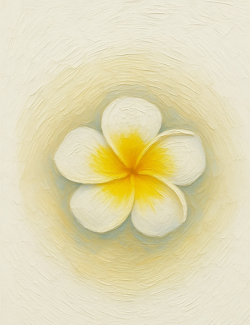
He did not notice the tiny white flower growing newly in the centre of the garden.
In the morning, Daimyo Imagawa had decided. He gave orders to muster a company of men from the fortress and the barracks in the town. Those insolent lords would pay what he was due, including additional fines in blood.
He felt so much better that on his way to the harbour he decided to linger in the garden, to savour the silence and the retribution to come. But once again his pleasure was spoiled. Lines were not perfect; elements were out of place. A white flower the size of a dinner plate grew among the rocks making up the garden’s central feature, pretty enough, but not right.
“Takanashi, if this garden isn’t to standard when I return I’ll have your head on a spike and the rest of you in the fire!” he roared into the morning quiet, and headed off down the hill.
The lord filled three ships with men and sharp steel and put to sea.
Once more, Daimyo Imagawa came home. The harbour was quiet, the atmosphere of the town sombre to match his mood – news had travelled back ahead of him. The neighbouring islands had met his forces and demands with unexpected resistance. Lord Sanjo’s men had even reinforced Lord Ogimachi in a pitched battle on the latter’s beach. It was unheard of! Hitherto, every other lord would rather have seen his rivals choking on their own blood than lift a manicured hand to their aid.
Insult of insults, Imagawa had received a glancing blow from a stone thrown at his retreating company as they fell back to their ships. He scratched at the wound now, flakes of rusty blood under his fingernails, and rage boiled within him.
He returned to the fortress only to be confounded further. He opened the gate to the walled garden to find the entrance barred by a profusion of white petals, each nearly as big as a man, their scent overpowering in his nostrils.
“What is this?” he sputtered. The soldiers behind him muttered their bafflement. “Takanashi!”
He found the attendant cowering in the main house. The man fell to his knees before his lord. “It is sorcery, Lord. When you cut it, it only grows back faster.”
“Nonsense, man. Did you find a gardener who might actually know what they’re doing?” sneered Imagawa.
“There are none to be found, Lord,” Takanashi whined. “The peasants have been drifting away, leaving Ukejima.”
Imagawa drew his katana from his belt. “Then why didn’t you stop them then?” he thundered. Takanashi scraped lower at his feet. “I ought to take your head right here. Get down to the town and select a dozen men, women and children and execute them on the quayside. Immediately! Make sure everyone sees. I’ll have no deserters. I want wailing in the streets!”
“At once, Lord.” Takanashi grovelled from his presence.
With weapon still drawn, Imagawa strode to the house entrance of the garden and sliced at the huge flower that now, incredibly, filled the whole space, pushing against the inner walls. The sharp blade cut into the tip of the nearest petal and stuck there. He wrenched it free. To his amazement, the wound closed before his eyes. Furious, he swung the katana and hacked at the growth again and again, chopping pieces into the air and scoring long slashes in the flower’s leathery flesh until at last he sagged back, exhausted. The graze on his head throbbed.
He watched blearily as the petals repaired themselves, grew anew, the glow of its inner life reasserted.
In the night, a crashing noise awakened Imagawa from an uneasy sleep. Part of the outer wall of the garden had collapsed. Unnatural white petals pushed through the paper panels of the house.
Daimyo Imagawa put to sea the next day with all the men he could muster.
The lords of the other islands had had enough of Daimyo Imagawa. For years they had suffered his taxes, his cruelty, his arrogance and that incredibly annoying strut as he walked into their palaces and fortresses as if he owned them, which he thought he did. Well no more!
The newly elevated Daimyo Sanjo had succeeded in uniting the squabbling lords under common cause. Their combined armies ambushed Imagawa as his forces laid siege to a suspiciously undermanned stronghold capping one of the nearby islands. They harried the survivors into the sea and all the way back to Ukejima.
Daimyo Imagawa found no sanctuary there. He stared, appalled at what he saw. His people had left him and his island had become changed. Fire burned his sails and arrows pierced his armour and his final expression was one of bewilderment to see the beauty that had replaced his ugliness.
The great flower bloomed from the crown of the hill, waves of white petals flowing down to the shore in a blanket of such beauty that the whole island shone like a jewel with the rising sun. The island was the flower, the flower the island. In time, the flower hardened to stone, like a sculpture carved by a god and set upon the surface of the sea.
Of Yutsuki, nothing was heard, but in the years that followed the islands became renowned for the beauty of their many gardens.

About the Author:
David McGillveray was born in Edinburgh, Scotland but now lives with his family in London. His fiction has previously appeared in Clarkesworld, Analog, Interzone and others. His story collection Forgotten Dragons, Plastic People is available through Amazon.